Ever heard of Professor Mohan Dutta? No, neither had I until a few days ago, when his name popped up on my computer screen. He occupies the Dean’s Chair in Communication at Massey University’s School of Communication, Journalism and Marketing, and what follows is his academic profile:
Based on his work on healthcare among indigenous communities, sex workers, migrant workers, farmers, and communities living in extreme poverty, Prof. Dutta has developed an approach called the culture-centered approach that outlines culturally-based participatory strategies of radical democracy for addressing unequal health policies. Based on academic-activist collaborations, the culture-centered approach uses fieldwork, resistive strategies for performance and dialogue-based reflexive participation to create entry points for listening to the voices of communities at the global margins. At the core of his research agenda is the activist emphasis on provincializing Eurocentric knowledge structures, and de-centering hegemonic knowledge constructions through subaltern participation. He has received over $4 million in funding to work on culture-centered projects of health communication, social change, and health advocacy. Recently, he completed a $1.5 million grant funded by the Agency for HealthCare Research & Quality (AHRQ) to develop a culturally-centered health communication project on heart disease among African American communities in the Lake and Marion counties of Indiana. This community-grounded project interrogating the unhealthy structures that constrain the health and wellbeing of African American neighborhoods in the US became the basis for multiple organic projects rooted in the aspirations in the community for health and wellbeing. At NUS, he received over $2 million in funding to run culture-centered projects of health across Asia, including projects on food insecurity in West Bengal, poverty and health in Singapore, health among migrant workers in low skilled sectors, health of transgender sexworkers, health among Malays, and cardiovascular health and marginalization. At Massey, he looks forward to building the work of CARE in the areas of indigenous health, health and migration, and poverty.
The social impact in Mohan Dutta's work bridges activist interventions and academic knowledge production, delineating the tensions, divergences and convergences when academics, activists, and communities come together in co-creating transformative practices. He is interested in theorizing the nature of productive practices of academic performance situated at the intersections of subaltern politics, activist commitments, and academic research. Professor Dutta explores these tensions in academic-activist-community collaborations through his own experiments with collaboration and solidarity.
In addition to teaching, writing and conducting fieldwork in collaboration with activist groups, Prof. Dutta enjoys spending leisure time with … [I edited this bit to protect his family’s privacy] and an extended family of performers and activists; stimulating conversations with his advisees, usually over meals; organizing opportunities in radical democracy with grassroots groups; and participating in creative production, script writing, and direction for 360 degree campaigns. In his most recent performance work, he has served as the visiting artistic director for Rittwick, a grassroots group in West Bengal, India working on performance for social change. He has also directed the "Singaporeans Left Behind" "Voices of Hunger" and "Respect our Rights" campaigns and documentary films. Prof. Dutta is the winner of the 2016 International Communication Association (ICA) Applied/Public Policy Communication Research Award, and the 2018 Outstanding Health Communication Scholar Award. He serves on the Advisory Panel of the World Health Organization (WHO) Cultural Contexts of Health (CCH) group.
What are we to make of all this? The first and most obvious point is that parts of it are written in a dialect that most people would find almost incomprehensible. That is its purpose. Elite groups have always used their own coded jargon to project (and protect) their power, to enhance their aura of exclusivity and to impress the impressionable. The object is not to explain, as most language strives to do, but to obscure, presumably in the hope that no one will detect its phony portentousness. No one does this stuff better than neo-Marxist academics. The university system is awash with this gibberish – a fact that would be comical if we weren’t paying for it.
The second conclusion we can reach on the basis of his profile is that Dutta is adept, like many of his ilk, at tapping into public funds – in this case from the AHRQ, which is part of the US Department of Health, and the National University of Singapore (NUS). The poor working schmucks whose taxes fund these institutions have no knowledge of, and even less control over, the radical agendas they enable. Unfortunately the same is true of New Zealand taxpayers who involuntarily fund activist academics and their tireless promotion of a world view that’s at odds with that of the majority of New Zealanders.
Dutta also appears to be good at bigging up his CV with awards and appointments – obligingly conferred, no doubt, by people who share an interest in pushing the same agendas. Demonstrations of mutual admiration are an essential part of the academic career path.
Fourth, and perhaps most important, we can reasonably deduce that Dutta is yet another import who has embedded himself in the tertiary education system and uses his privileged position to white-ant the society that provides his living. Explicit in his profile is a commitment to radical change; whether New Zealanders want it or approve of it is immaterial.
Am I unfairly picking on Dutta? After all, there are dozens – hundreds? – of other academics like him, all pushing an agenda that’s fundamentally hostile to the capitalist, democratic system that most New Zealanders were brought up with, believe in and support. North Americans in particular have proved adept at burrowing into our academic institutions and stoking the culture wars. I suspect they’re quietly thrilled at having found a blank canvas on which to leave their ideological imprint – a place where lecture theatres are full of gullible, know-nothing students waiting to have their empty minds filled with whatever pernicious tosh their teachers serve up to them. The tragedy is that New Zealand's cultural cringe – the deeply ingrained conviction that people from other countries must know more than we do – allows this to happen. The capture of our academic institutions by activists and disrupters from the extreme Left has gone unchallenged.
Wednesday, June 7, 2023

Sunday, June 4, 2023
The NZTA's worse than useless road signs
Not that I’m picking on the NZTA or anything (see earlier post), but does New Zealand have the world’s worst road signage?
I’ve expostulated on this subject before, to the extent that it’s threatening to become something of a personal obsession. What got me started again was our recent road trip, during which I saw some bizarre examples of irrational signage that seemed expressly designed to bamboozle travellers or send them the wrong way.
Example No. 1: on SH22, which is the back road from Raglan to Pukekohe (incidentally, a lovely route, worth taking if you’ve got the time), there’s an intersection near Waingaro Hot Springs where you can turn right toward Ngaruawahia and SH1 or left to carry on north toward Pukehoke, which is where we were going. But does the sign pointing left mention Pukekohe, Tuakau or any other recogniseable place name? No, it tells you that the road leads to a place called Te Akau – a mere dot on the map (Wikipedia describes it as a small farming settlement) that few people from outside the district would have heard of. Not recognising the name Te Akau and wanting to head north toward Tuakau, I headed down the wrong road for a couple of minutes before sensing there must be some mistake and turning back.
Here’s the thing: the only people wanting to go to Te Akau are likely to be locals, who of course already know where it is. Strangers to the area – i.e. the people who depend on signs to get them to the right place (are you listening, NZTA?) – are likely to be looking for names that mean something. Pukekohe, for example, or Tuakau.
I saw several other examples of utterly useless signs pointing to no-name places rather than to localities that travellers actually want to get to. Did you know, for example, that when you head west from Paihia, the big NZTA sign beside the road tells you you’re going to Puketona? That’s right: Puketona. Not Kerikeri or Kawakawa or Mangonui or Kaitaia or any other place that people have heard of and want to get to, but another dot on the map that appears to have been put on the sign for no better reason than that it happens to be on the intersection where the road from Paihia links up with SH1.
Oheawai in Northland is another case in point. Signs on SH12 repeatedly tell you you’re heading toward Oheawai – yet another tiny dot – but make no mention of the more substantial places people might be heading for. Like Puketona, Oheawai is at a junction. I suspect the nerdish mindset in the NZTA is that junctions are important and therefore dictate what should be put on signs, regardless of whether the place names mean anything to anyone.
Example No 2: heading towards Auckland from Clarks Beach, on the southern shore of Manukau Harbour, wouldn’t you expect the signs to say just that: “Auckland”? Ha! Far too logical. Instead, the signs tell you you’re on the way to Papakura. Auckland doesn’t get a mention. Many New Zealanders have only a vague idea of where Papakura is and few strangers to the district are likely to be going there. They do, however, want to be sure they’re on the road to Auckland. But for reasons apparent only to itself, the NZTA has decided that information isn’t necessary. What, I wonder, would overseas tourists make of it? Not having heard of Papakura, they would understandably worry that they must be on the wrong road.
And here’s another strange phenomenon: the case of the disappearing destination. I’ve encountered this frequently and struck it again on the northwestern motorway (SH16) out of Auckland, where the signs initially point, quite rationally, to Helensville. But then Helensville inexplicably drops off the signage and Wellsford pops up in its place. Later it’s Wellsford’s turn to vanish and Helensville is mysteriously reinstated. The result, for people navigating SH16 for the first time, is likely to be confusion, at the very least. It wouldn’t surprise me if flummoxed drivers pull off the motorway because they’re suddenly wondering whether they’re still on the right route. Consistency in signage is important.
There’s also the reverse phenomenon, where a place name is invisible until you’ve virtually arrived. Example: if you’re heading toward Raglan from the south and take the most direct route by turning off SH3 at Otorohanga, the signs tell you only that you’re on the way to Kawhia. Despite being a far bigger place (population 4000, compared with Kawhia’s few hundred), Raglan doesn’t rate a mention. It’s not till you get to a major intersection at Whatawhata, west of Hamilton, that the popular surfing and holiday town suddenly shows up on road signage. The NZTA seems to assume that the only people travelling to Raglan are coming from the north and east. (I should add that as well as pointing only to Kawhia, the sign at Otorohanga is in a position where it’s very easy to miss – another regular NZTA flub.)
Anyone reading this rant might assume that I wrote it in a fit of rage after repeatedly taking wrong turns on our road trip, some of which was in unfamiliar territory. Not so. Only twice did I briefly get misled (the other time was at Herekino, in the Far North). I pride myself on knowing the country well enough, and having a sufficiently sound sense of direction, not to get bushed. But I did repeatedly curse misleading or ambiguous signs that made me pause and double-check, and I wondered time and again how much more confounding it must be for travellers with little knowledge of New Zealand geography.
Overall, I get the impression the NZTA's signage policy is determined by someone with a degree – possibly a PhD in critical signage theory – sitting at a computer in Wellington and applying a rigid theoretical approach (the emphasis on road junctions suggests this) rather than by people actually out on the road tackling the issue from a practical, common-sense standpoint – that is to say, constantly asking themselves: “What information are motorists most likely to need here?”. (I’m available to the NZTA for a modest consultant’s fee. I certainly couldn’t do a worse job than whoever’s designing the signage now.)
A possible aggravating factor is that the AA appears to have withdrawn from its traditional signposting role. There was a time when every district had a resident AA agent who knew his territory intimately (I'm not being sexist - it was invariably a bloke) and whose duties included ensuring all roads were clearly signposted. But the AA these days is a very different beast and may have abandoned that useful function.
Whatever the explanation, I find it hard to believe that the designers of road signage ever put themselves in the position of the typical road user, still less consider the challenges faced by overseas travellers – of whom there are many – trying to navigate an unfamiliar country.
Perhaps the central planners assume every vehicle has Sat Nav and no one needs help, in which case the NZTA might as well dispense with signage altogether. I can think of any number of places where they might as well do exactly that, given that the existing signs are often worse than useless.
Friday, June 2, 2023
Please, Stuff, spare us the hypocritical rhetoric
There was more flatulent corporate blather yesterday from Stuff about its proud heritage.
In statements accompanying the announcement of a corporate restructuring, former Christchurch Press editor Joanna Norris – who now becomes managing director of Stuff Masthead Publishing, which apparently means she will take charge of metropolitan mastheads and websites – said: “Drawing on our 160-year history of journalism, we are reinvigorating and growing the portfolio of iconic journalism brands which are embedded in communities across New Zealand.”
Stuff likes to cite its journalistic legacy when it suits, but it has shown precious little respect for it. Often quite the contrary.
When it announced the phasing out of the Dominion Post masthead in April, it heaped scorn on the name Dominion, depicting it as a shameful hangover from colonialism. But the Dominion, although it was one of the younger daily papers in the country (established in 1907), was the starting point of what is now the Stuff group. It’s a strange thing for a company to skite about its heritage while simultaneously disowning a paper that formed its very foundation.
On that note, I should record again that when Alan Burnet, former managing director and later chairman of the Independent Newspapers Ltd (INL) group, died last year aged 101, I offered to write his obituary for the Dom Post. They weren’t interested.
The significance of this was that Burnet was the prime mover in creating the newspaper group that is now Stuff (although it was an infinitely stronger company then than now). The only reason Stuff owns those “iconic journalism brands” that Norris proudly refers to – the former Evening Post and Dominion, the Press, the Waikato Times, the Sunday Star-Times, the Southland Times, the Nelson Mail, the Manawatu Standard, the Taranaki Daily News, the Timaru Herald, the Marlborough Express – is that Burnet and his successor Mike Robson pulled them all together to form the nationwide group known as INL, which eventually morphed into Stuff.
To put it another way, Stuff wouldn’t exist had it not been for Burnet. Yet they declined to honour him with an obit, I suspect because he was an old white guy and they didn’t want to be reminded of their ideologically unfashionable roots. In the end my obit was published by the BusinessDesk website and by Burnet’s original home-town paper the Whanganui Chronicle, although it’s owned by Stuff’s rivals NZME.
Stuff doesn’t appear to be entirely ignorant of its own history, embarrassing though that history may be to its current management. The last edition of the Dom Post (now simply The Post) on April 28 announced the killing-off of the old name in a story headlined “Standing on the shoulders of giants” – an apparent acknowledgment of the generations of talented, dedicated journalists who worked for the Dominion and Evening Post and made them the successful and respected titles they were. Perhaps that headline was sneaked through by a subversive sub-editor who understood the paper’s history better than its owners do.
It wouldn’t have escaped the attention of long-term readers that two of the three stories the Post’s editor, Caitlin Cherry, cited as evidence of the paper’s supposed commitment to rigorous journalism happened long before the present regime took over. And the third example she pointed to – the coverage of last year’s parliamentary protest – seemed a curious choice, since the paper did no more than should have been expected of any half-competent news organisation. After all, the story was breaking in full public view right outside the centre of government. If that was the paper’s proudest moment under Stuff’s ownership, the cupboard is worryingly bare.
Incidentally, Stuff’s story about the launching of The Post included a message to readers that contained the sentence: “All of this innovation and rebranding doesn’t mean we are turning our back on our proud history.” Oh, but they have. Under its current management, Stuff has followed the example of its former proprietors, the Australian group Fairfax, by continuing to methodically eradicate much of what made the precursor company, INL, so successful. The gutting of its titles, the hollowing-out of its newsrooms (the casualties of which included some of the company’s most capable journalists) and the inevitable subsequent collapse of its readership can only partly be blamed on the impact of digital technology, catastrophic though that was.
And what about that weasel word “proud”? This is the same company that, three years ago, indulged in an extravagant, breast-beating mea culpa, complete with front-page apology, about its supposedly racist history. In the process, it casually defamed generations of former employees, most of whom didn’t have a racist bone in their body.
Obviously, Stuff needs to make up its mind about whether or not it’s proud of its heritage. Either it is or it isn’t.
As for Norris's statement that Stuff is "reinvigorating" its brands ... really? That will come as news to employees who have been through repeated downsizings and are reportedly bracing for a further round of redundancies. Who do Stuff think they're kidding? If credibility means anything to them, they would spare us the hollow, hypocritical rhetoric.
Thursday, June 1, 2023
Jeremy Clarke will be missed
I was saddened to read this week of the death on May 21 of Jeremy Clarke, who wrote the Low Life column in the British magazine the Spectator.
Readers knew his death was coming because he chronicled his decline week by week, sometimes in unsparingly explicit terms. But in a way, that made the end all the more poignant. Each week I would scan the Spectator’s contents page to see whether he was still there. Eventually, he wasn’t. But I marvelled at his ability to keep churning out wryly humorous and usually self-deprecating columns, even in acute pain on his deathbed.

Jeremy Clarke (left) with the Spectator's High Life columnist, Taki Theodoracopulos (better known simply as Taki).
Clarke, who was 66, stood apart from the clique of Eton- and Oxbridge-educated toffs who make up the core of the Spectator stable of writers. In fact he rejoiced in his proletarian enthusiasms – hence the title of his column. Unlike some of his better known fellow columnists (Charles Moore, Toby Young, Matthew Parris, Douglas Murray), he never lapsed into pomposity or preciousness. Neither did he show any propensity for name-dropping.
When I began reading him, more years ago than I care to think about, his columns were mostly devoted to his misadventures with an assortment of ne’er-do-well friends. Pubs and parties were the most common settings for his stories, which typically involved the consumption of copious quantities of alcohol and other drugs. The escapades and characters he described were sometimes so outlandish that I wondered whether he made them up, or at least embellished them. But he didn’t seek to glamorise his wayward lifestyle; in fact the tone was usually more remorseful than boastful.
In more recent years he moved to a new home in a cave in the south of France and seemed to mellow – a change that coincided with the onset of prostate cancer and the development of a serious relationship with the woman who cared for him in his last months, and whom he proudly married only a short time before his death.
One of the first thoughts that occurred to me on learning of Clarke’s death was that he’s likely to be desperately missed by his two grandsons, who frequently featured in his columns. He was devoted to them and they, obviously, to him. They will be joined in their mourning by legions of Spectator readers around the world.
Notes on a road trip to the Far North
My wife and I recently returned from a 3000km road trip to the Far North via Taranaki. Here are some of the things we discovered (or in some cases, rediscovered):
■ New Plymouth has a great craft beer bar called Shining Peak (no prizes for guessing what inspired the name). On a vile Wednesday evening when sane people would have been at home, the place was humming. The beer was excellent, the staff were friendly and efficient and the convivial atmosphere reminded me of a good English pub. The food looked good too, though we didn’t eat there. Yet another reason to like one of New Zealand’s most appealing cities.
■ New Zealand has an extremely fragile roading system. Well, we all knew that, but it has never been more acutely apparent. The night before we were to drive through the Awakino Gorge to the Waikato on SH3, we learned that the road was closed after a section of it fell into the river. That forced us to backtrack from New Plymouth to Stratford and take the aptly named Forgotten World Highway through Whangamomona and Taumarunui.
■ New Zealand must hold some sort of world record for the time required to clear roads after serious accidents. Before we even got to Stratford, we found ourselves stuck in a tailback stretching several kilometres following a crash involving a logging truck and an ambulance. The accident happened at 5.20am. We joined the queue at 9.10am. Nothing was happening. It wasn’t until 10 o’clock that a mobile crane headed past us to the crash scene, presumably to move the logging truck. Why the delay? This is a major state highway; re-opening it after a crash should be treated as a matter of urgency. Meanwhile, the NZTA’s website was advising travellers to delay their journey or go the long way around Mt Taranaki on the Surf Highway – not very helpful when we were already en route and didn’t want to risk taking a two-hour detour around the mountain only to then learn the road had been cleared five minutes after we left, which Sod’s Law suggests was bound to happen. At 10.30, more than five hours after the accident, a traffic control truck moved slowly along the line of waiting vehicles with the news that we still faced an indeterminate delay. No explanation why. The guy in the truck was sympathetic but didn't appear to know any more than we did. At that point, everyone turned around and dispersed. Most headed back toward New Plymouth, but we found a way around the crash site using rural backroads and took less than 15 minutes to get back on track. We’d probably still be stuck there if it wasn’t for Google Maps. The incident not only confirmed my sceptical view of the NZTA’s traffic management expertise, but also raised questions in my mind about the role of the police serious crash unit. There was a time when the main priority after a crash – that is, once ambulances and firefighters had done their vital work – was to get traffic flowing again. Now accident scenes seem to be frozen until the serious crash unit arrives (however long that takes) and completes whatever it is that serious crash units do. In the meantime traffic backs up, people miss vital appointments and tempers get frayed. The Wairarapa Times-Age this morning reports a similar incident yesterday: SH2 over the Remutaka Hill was closed from 7am till 11.45 am – the peak morning period for commuters to Wellington – while police investigated a fatal crash scene. The NZTA lamely suggested motorists take the Saddle road via Woodville, a journey of an extra three hours. Is this another example of the cult of box-ticking, form-filling managerialism that the police seem to have succumbed to, and which prioritises protocols and process over people? I suspect it is. There must be a point at which any benefit derived from time-consuming crash investigations is outweighed by the disruption and inconvenience these investigations cause to thousands of people. Anyway, in the event, what should have been a three-hour journey from New Plymouth to Raglan ended up taking eight hours. The scenery was nice, though – at least, when we could see through the rain.

The lovely settlers' church at Awhitu. Don't tell anyone from Auckland.
■ Awhitu Peninsula, on the southern side of the entrance to Manukau Harbour, is a lovely and largely unknown corner of New Zealand. The views are spectacular and it’s unexpectedly wild in places. After a lifetime of travelling on remote roads throughout the country, it was the first time I’ve had a deer run across the road immediately in front of me (this in a deep, bush-clad gully). I had to dodge a few pheasants too. Please don’t tell anyone about this charming place. If Aucklanders discover it, it’ll be stuffed.
■ Speaking of views, it’s hard to suppress a gasp when Hokianga Harbour reveals itself as you crest the hill approaching it from the south on SH12. It’s one of the most spectacular vistas in the country. There’s now a roadside picnic area so you can pull off and enjoy the scenery at your leisure, which I don’t remember being there last time we passed through.
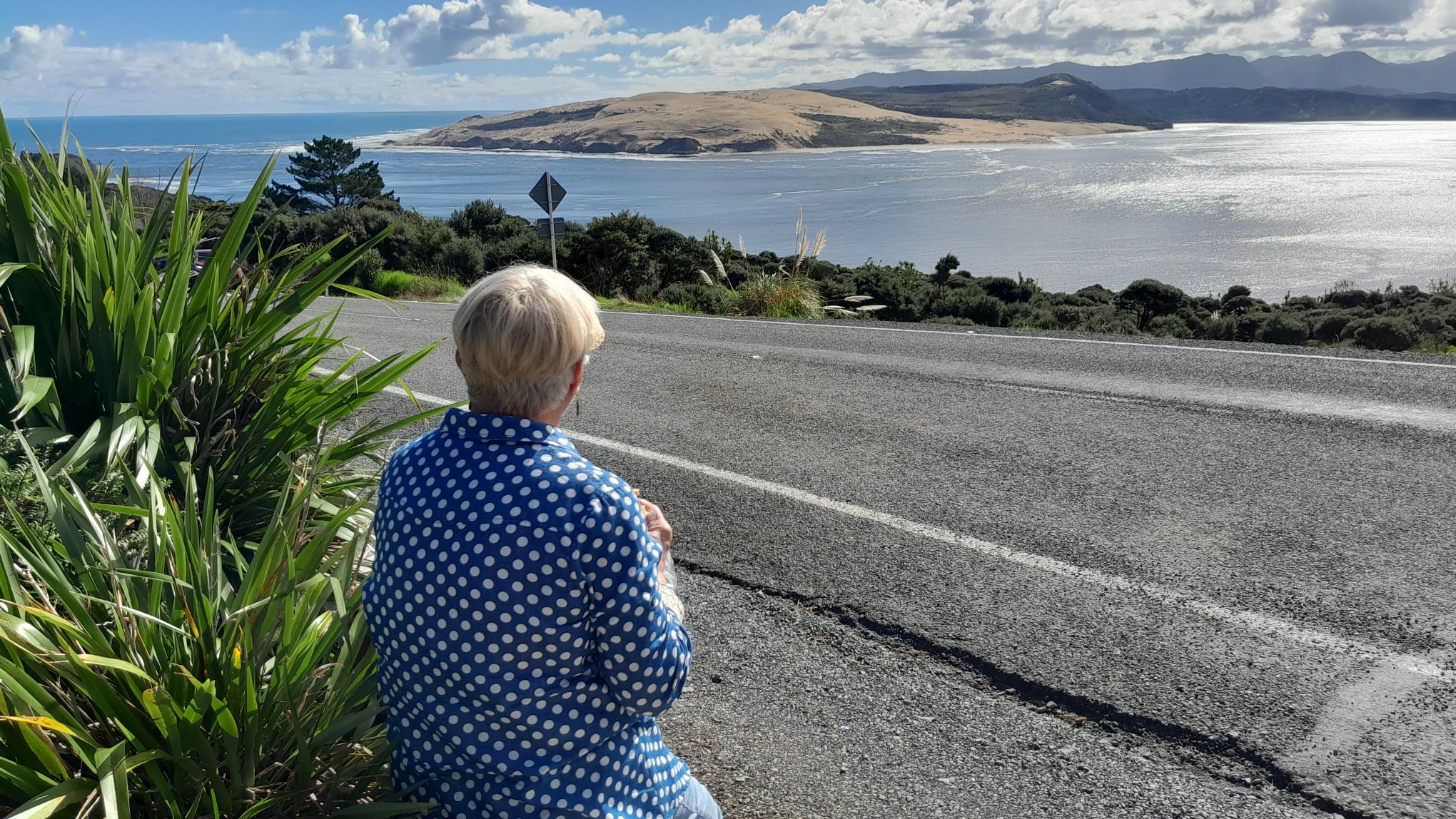
The view over Hokianga Harbour. The mysterious blonde eating her lunch in the foreground inexplicably turned up everywhere I stopped.
■ Don’t assume that just because the website of the popular Opononi
pub says it’s open every day from 11am till late, it actually will be. When I
tried to book a table for dinner, thinking the restaurant might be busy on a
Sunday night, I was told they closed at six. The staff were all young mums, the
lady behind the bar explained, and they liked to be home in the evening with
their kids. Fair enough; I heartily approve of families coming first, and fortunately
there was a fish and chip shop a few doors away, so we weren’t going to starve.
But …
■ Don’t assume either that when the bloke who runs the Opononi fish and chip shop says they close at seven, they actually do. We were fortunate to get our order in early, because he made a spur of the moment decision to shut at six. Tough luck for anyone who arrived later. Lesson: they do things differently in Opononi. Nice fish and chips though.
■ Speaking of fish, don’t assume it’s cooked fresh from the sea at the Whangaroa Harbour Sports Fishing Club’s café. Some of the best fishing grounds in the world lie just offshore but the only fish on the menu was frozen dory (not john dory, but the inferior oreo type) which I suspect was caught by an industrial trawler hundreds, if not thousands, of kilometres away. Zane Grey would not have approved. The staff were friendly though, and we had a great motel room at Whangaroa, with a glorious view over the harbour. (We stayed in motels all along the way and there wasn’t a dud among them.)

■ Everywhere we went we were confronted by the ravages of
Cyclones Hale and Gabrielle and miscellaneous other recent adverse weather events; even the
walking track to the Cape Reinga lighthouse was closed. The bad weather wasn’t
over, either. We repeatedly struck freakishly violent squalls with rain so
intense that I almost had to pull over and stop (nothing to do with the Hunga-Tonga eruption, you understand; the experts insist it’s all down to long-term climate change). Of course damaged roads
can’t be helped, and we just had to be patient at the many places
where traffic was held up by repair work. Less understandable, and infinitely
less tolerable, was the number of times we were slowed or brought to a complete
halt where nothing was happening. Twice we joined a line of vehicles following
a traffic control truck at a snail’s pace over a section of road where no
work was in progress and there seemed no reason for the ritual procession,
other than that the men in the truck were bored and needed something to do. In
other places 30kmh speed limits were imposed where there wasn’t a road worker
in sight or a piece of machinery operating. Even where work was in progress, the
number of vehicles actually fixing the road was invariably greatly exceeded by
traffic control trucks doing nothing except ostentatiously parading back and forth with their flashing lights. I’m reluctant
to use pejorative terms such as loafers and parasites, but that’s how I’ve come
to view the traffic control enforcers in their hi-vis vests and ubiquitous shiny white trucks. I suspect they’ve become the most hated occupational
group in the country. (The other day I saw a traffic control vehicle displaying
the brand name Men at Work. Whoever named the company has a fine sense of
irony.)
■ In an ideal world, every New Zealander would visit the Treaty Grounds at Waitangi. I defy anyone with an open mind to spend time in the two impressive museums there and not come away with a better understanding of Maori grievances and of our highly nuanced, 50-shades-of-grey history. And no, I’ve not suddenly gone woke. Every time I drive anywhere in New Zealand through magnificent landscapes once occupied by Maori but now controlled by Pakeha - land that was once theirs but now is not - I get a glimmer of insight into why many people of Maori descent feel aggrieved. We are all captives of our complicated history and the country’s future largely depends on whether (and how) we can resolve tensions and contradictions arising from past events that can’t be retrospectively wished away, no matter how much we might like to.
■ I’ve never quite been sure about the late artist and architect Friedensreich Hundertwasser, who’s best known in New Zealand for the famous public dunny he designed in Kawakawa. Part of me always suspected he was, as much as anything, an accomplished self-publicist with fawning, impressionable admirers in all the right circles. But the Hundertwasser Art Centre in Whangarei is magnificently eccentric – a wonky delight, and a good reason to visit a city that otherwise doesn’t seem to have much to commend it. It’s hard to wander around the building without (a) smiling and (b) marvelling at the work that went into it. A documentary about Hundertwasser reveals a man of prodigious energy, imagination and creativity – which is not to say he didn’t also have a talent for bullshit.

■ There’s a great wine shop in the main street of Cambridge
with a range of imported wines as good as any you’ll see in the big cities. Not
cheap, but obviously there are people in affluent Cambridge who can afford
them.
■ There are places where history feels very close. One such place is Ruapekapeka, on a hilltop south of Kawakawa – site of an historic battle in 1846 between 1600 British troops and 400 Ngapuhi and Ngati Hine warriors led by the chief Kawiti. The Maori defenders surprised the overwhelmingly larger British force by successfully withstanding a prolonged bombardment and siege through the ingenious design of their fortifications. One British officer called the stockade a model of engineering. At Ruapekapeka you can wander among the defensive earthworks and look down into the dugouts where the defenders sheltered from enemy fire (and from which Ruapekapeka, meaning bat’s nest, gets its name). The battle ended with the Maori withdrawing, but contrary to British propaganda, it was a hollow victory for the imperial power. Other countries would proudly celebrate such sites, but New Zealand seems strangely reluctant to honour its rich and unique history. It’s obvious that money has been spent enhancing the entrance to Ruapekapeka, yet you could still drive past it and not realise it’s there; it was only a road sign saying Monument Rd that made me stop and look around before realising I’d found the place. Most of the signs identifying the site seem to have been ingeniously concealed behind trees. Much the same is true of the important battle site at Rangiriri, just off SH1 north of Huntly. It’s at the end of a dead-end street without a parking area. There’s an information board, but the sign indicating that this is where a decisive battle was fought in 1863 is obscured behind a scruffy shrub, and the overgrown path leading up a small hill to the Maori redoubt is barely visible. We could and should do a lot better.

■ The Auckland Effect is my term for the steadily widening
perimeter around Auckland where you can see the conspicuous imprint of Auckland
wealth. Over the decades the AE has inexorably spread up the east coast of
Northland, though it’s less obvious on the west side. You can see it also
extending its tentacles down into the Waikato and over into the Bay of Plenty.
It’s evident mainly in the extraordinary proliferation of ultra-expensive
houses, many of which had drawn curtains, indicating they’re
used as holiday homes. I found myself idly wondering who owns all these
fabulously opulent residences with million-dollar views. How and when did New
Zealand produce so many extremely rich people? The Auckland Effect is the
ultimate proof that the egalitarian country I grew up in has irrevocably passed
into history.
Overall impressions: New Zealand may be going to the pack in multiple ways. Its infrastructure is collapsing, the economy is sick, the education system has been ruinously contaminated by extremist ideology (even maths is now apparently treated as an expression of white privilege) and the deranged culture wars are raging to the point where democracy itself is at risk. But physically it’s still a beautiful country - no one can change that - and the people are friendly and good-hearted. They deserve far better from those who purport to represent them.

Friday, May 26, 2023
A fresh appraisal of an unfashionable subject
I’ve just finished reading a recently published book by my friend and long-ago boss, the Sydney-based New Zealand author and journalist Robin Bromby.
Tepid Whisky by Paraffin Lamp is subtitled Life and Work in Outposts of the British Empire in the Twentieth Century. It’s a very detailed and substantial piece of work on an aspect of history that most scholars either shy away from or approach in antagonistic terms because it’s considered ideologically beyond the pale.
Robin himself acknowledges that the history of the British Empire is “a subject one addresses now with caution”. From a 21st century perspective, the idea that European imperial powers could claim ownership over foreign territories at will, even when they had no particular purpose for them (as was sometimes the case), is unthinkable. But there was a time in living memory when it was considered entirely natural – in fact a matter of pride – that the sun never set on the British Empire. And as Robin notes, the administrators who ran those distant outposts were often motivated by high ideals.
They needed to be, because the rewards were often scant. Contrary to popular belief, the typical colonial official did not lead a life of luxury and privilege. Conditions were often brutally harsh. Heat (and sometimes cold), disease, primitive housing, inadequate remuneration and unimaginable loneliness were some of the prices colonial officials paid for the privilege of serving the Empire.
Communication with the outside world was chancy and erratic at best, as were visits from supply ships. More often than not, fresh food was unprocurable. In particularly remote locations, the colonial officer could go weeks or even months without seeing another European. Conventional family life was out of the question; officers often had to leave their children behind in England or were forbidden from having a family at all. It certainly wasn’t all polo, pink gins and punkahwallahs waving pandanus fans to keep the sahib cool, as readers of Somerset Maugham might imagine.
Perhaps surprisingly, given Britain's imperial wealth, the Colonial Office in London was a parsimonious employer. Not only did it pay its officers poorly, but they were strictly limited in the creature comforts they could take with them and were only rarely allowed trips home. Long-suffering wives were expected to entertain visiting dignitaries despite not being given the means to do so. Even alcohol allowances were miserly.
Robin reveals that colonial administrators were typically the best and brightest of their era – graduates of Oxford or Cambridge, accomplished at sport and well-connected socially. The demands on them were immense. A district officer in his early 20s was likely to find himself in sole charge of an area the size of Wales or Scotland and responsible for everything from the maintenance of law and order (both as police chiefs and magistrates) to the building of schools and roads, the conduct of inquests, the settling of tribal disputes, the conduct of inquests, the collection of taxes and even the dispatching of marauding wild animals. Some colonial administrators eventually returned home and went into politics but many spent their lives being cycled through postings that could take them to places as scattered as Sierra Leone, Hong Kong, Sudan, Aden, Trinidad, the Solomon Islands, Somaliland, Tristan da Cunha and the Falkland Islands.
Robin doesn’t gloss over the rampant economic exploitation that took place under colonialism or the shameful way Britain took advantage of native manpower from the colonies in wartime, but he points out that British administrators built schools, roads, hospitals, railways and sanitation systems. Much of that infrastructure is still in use today. Tepid Whisky by Paraffin Lamp is not only rigorously researched – a prodigious feat in itself – but presents a nuanced and non-judgmental appraisal of a period in history that generally gets a bad press. The book is available here.
Tuesday, May 23, 2023
Just another day at Wellington City Council ....
There are some situations so absurd that only humour can adequately capture their lunacy. Wellington city councillor Nikau Wi Neera, who was elected last year to represent the city's Maori ward, has filed a notice of motion calling on the council to mark Nakba Day – a commemoration of Palestinian displacement in 1948 – by officially recognising the state of Palestine and lighting up the Michael Fowler Centre in the colours of the Palestinian flag.
This is too out-there even for Wi Neera’s fellow Greenie and avowed Palestine supporter, mayor Tory Whanau, but that doesn’t mean the proposal is dead in the water. It will come before the full council next month, and there are enough ideological zealots (i.e. Tamatha Paul) and flakes (Iona Pannett, Rebecca Matthews) around the table to give it a reasonable chance of success. In the meantime, someone has wickedly spoofed it using a now-familiar meme from the movie Downfall, deftly skewering the council’s fatuous woke pretensions and neatly making the point that ordinary Wellingtonians probably have more pressing issues on their minds than Palestinian liberation.
Subscribe to:
Posts (Atom)