Ever heard of Professor Mohan Dutta? No, neither had I until a few days ago, when his name popped up on my computer screen. He occupies the Dean’s Chair in Communication at Massey University’s School of Communication, Journalism and Marketing, and what follows is his academic profile:
Based on his work on healthcare among indigenous communities, sex workers, migrant workers, farmers, and communities living in extreme poverty, Prof. Dutta has developed an approach called the culture-centered approach that outlines culturally-based participatory strategies of radical democracy for addressing unequal health policies. Based on academic-activist collaborations, the culture-centered approach uses fieldwork, resistive strategies for performance and dialogue-based reflexive participation to create entry points for listening to the voices of communities at the global margins. At the core of his research agenda is the activist emphasis on provincializing Eurocentric knowledge structures, and de-centering hegemonic knowledge constructions through subaltern participation. He has received over $4 million in funding to work on culture-centered projects of health communication, social change, and health advocacy. Recently, he completed a $1.5 million grant funded by the Agency for HealthCare Research & Quality (AHRQ) to develop a culturally-centered health communication project on heart disease among African American communities in the Lake and Marion counties of Indiana. This community-grounded project interrogating the unhealthy structures that constrain the health and wellbeing of African American neighborhoods in the US became the basis for multiple organic projects rooted in the aspirations in the community for health and wellbeing. At NUS, he received over $2 million in funding to run culture-centered projects of health across Asia, including projects on food insecurity in West Bengal, poverty and health in Singapore, health among migrant workers in low skilled sectors, health of transgender sexworkers, health among Malays, and cardiovascular health and marginalization. At Massey, he looks forward to building the work of CARE in the areas of indigenous health, health and migration, and poverty.
The social impact in Mohan Dutta's work bridges activist interventions and academic knowledge production, delineating the tensions, divergences and convergences when academics, activists, and communities come together in co-creating transformative practices. He is interested in theorizing the nature of productive practices of academic performance situated at the intersections of subaltern politics, activist commitments, and academic research. Professor Dutta explores these tensions in academic-activist-community collaborations through his own experiments with collaboration and solidarity.
In addition to teaching, writing and conducting fieldwork in collaboration with activist groups, Prof. Dutta enjoys spending leisure time with … [I edited this bit to protect his family’s privacy] and an extended family of performers and activists; stimulating conversations with his advisees, usually over meals; organizing opportunities in radical democracy with grassroots groups; and participating in creative production, script writing, and direction for 360 degree campaigns. In his most recent performance work, he has served as the visiting artistic director for Rittwick, a grassroots group in West Bengal, India working on performance for social change. He has also directed the "Singaporeans Left Behind" "Voices of Hunger" and "Respect our Rights" campaigns and documentary films. Prof. Dutta is the winner of the 2016 International Communication Association (ICA) Applied/Public Policy Communication Research Award, and the 2018 Outstanding Health Communication Scholar Award. He serves on the Advisory Panel of the World Health Organization (WHO) Cultural Contexts of Health (CCH) group.
What are we to make of all this? The first and most obvious point is that parts of it are written in a dialect that most people would find almost incomprehensible. That is its purpose. Elite groups have always used their own coded jargon to project (and protect) their power, to enhance their aura of exclusivity and to impress the impressionable. The object is not to explain, as most language strives to do, but to obscure, presumably in the hope that no one will detect its phony portentousness. No one does this stuff better than neo-Marxist academics. The university system is awash with this gibberish – a fact that would be comical if we weren’t paying for it.
The second conclusion we can reach on the basis of his profile is that Dutta is adept, like many of his ilk, at tapping into public funds – in this case from the AHRQ, which is part of the US Department of Health, and the National University of Singapore (NUS). The poor working schmucks whose taxes fund these institutions have no knowledge of, and even less control over, the radical agendas they enable. Unfortunately the same is true of New Zealand taxpayers who involuntarily fund activist academics and their tireless promotion of a world view that’s at odds with that of the majority of New Zealanders.
Dutta also appears to be good at bigging up his CV with awards and appointments – obligingly conferred, no doubt, by people who share an interest in pushing the same agendas. Demonstrations of mutual admiration are an essential part of the academic career path.
Fourth, and perhaps most important, we can reasonably deduce that Dutta is yet another import who has embedded himself in the tertiary education system and uses his privileged position to white-ant the society that provides his living. Explicit in his profile is a commitment to radical change; whether New Zealanders want it or approve of it is immaterial.
Am I unfairly picking on Dutta? After all, there are dozens – hundreds? – of other academics like him, all pushing an agenda that’s fundamentally hostile to the capitalist, democratic system that most New Zealanders were brought up with, believe in and support. North Americans in particular have proved adept at burrowing into our academic institutions and stoking the culture wars. I suspect they’re quietly thrilled at having found a blank canvas on which to leave their ideological imprint – a place where lecture theatres are full of gullible, know-nothing students waiting to have their empty minds filled with whatever pernicious tosh their teachers serve up to them. The tragedy is that New Zealand's cultural cringe – the deeply ingrained conviction that people from other countries must know more than we do – allows this to happen. The capture of our academic institutions by activists and disrupters from the extreme Left has gone unchallenged.
Showing posts with label Neo-Marxism. Show all posts
Showing posts with label Neo-Marxism. Show all posts
Wednesday, June 7, 2023

Saturday, February 5, 2022
If we're going to talk about decolonisation, let's go the whole hog
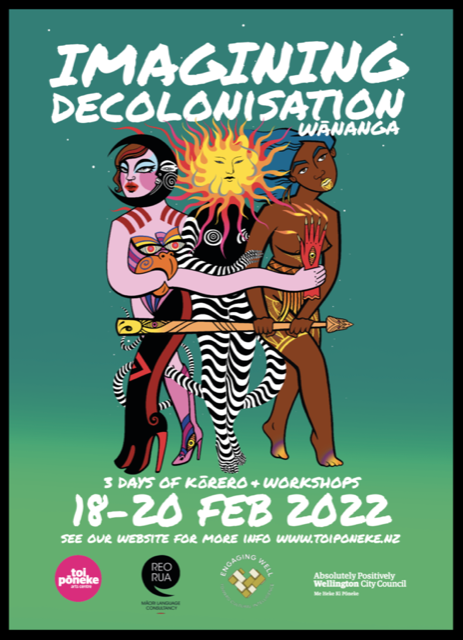
Some of New Zealand’s most divisive mischief-makers are
embedded in local government, where they appear free to pursue their ideological
agendas unencumbered by any checks or restraints, generously subsidised by
ratepayers who are given no chance to say whether or not they approve of their
money being spent on extremist causes.
A perfect example is a forthcoming 3-day wananga (forum) organised by the Wellington City Council-funded Toi Poneke arts centre and entitled “Imagining Decolonisation”, for which the capital’s long-suffering ratepayers will pick up a big part – if not all – of the tab.
To convey the tone of this event, I can do no better than quote from an official council press statement:
The event … will bring together academics, students, artists, writers, treaty workers, activists, politicians and change makers to discuss and create steps towards what an equitable future in a decolonised Aotearoa could look like.
Wellington City Council’s Tati Heke Karepa Wall [translation: head of Maori strategic relationships] welcomes the event.
“Kua rewa anō te waka – piki mai inā koia te koronga o te Ngākau kia kakea rā ngā tāpuhipuhitanga o te whakaaro! So many in our community are now the new catalysts of decolonisation simply because our community now better understands and appreciates the complexities of Maori self-determination.
“We have been through a process of unlearning some of our past – and now the time is to come together and relearn in order for us to move forward together,” says Karepa.
The “Imagining Decolonisation” wānanga provides a line-up of speakers and workshop leaders including artists and musicians Ruby Solly and Ariana Tikao, Psychiatrist Dr Di Kopua, academic Emalani Case (VUW), campaigner Kassie Hartendorp (Action Station), environmentalist Catherine Delahunty (Kōtare), Councillor Tamatha Paul, Green Party MP Dr Elizabeth Kerekere, dance artist Lusi Faiva, and youth activist Safari Hynes. Experiential workshops across diverse mediums will provide an opportunity for discussion and creative expression.
Councillor Tamatha Paul is pleased to be a part of the event for a number of reasons.
“If Covid has shown us anything, it is the illumination of deep-rooted inequality in New Zealand. Amidst trying to keep our communities safe, trying to keep a roof over our heads and stay afloat, there has been little time to dream of a decolonised Aotearoa.
“I’m excited to be in wānanga with rangatira and rangatahi to collectively imagine a better, fairer society and to inspire action.”
(For a more detailed breakdown, if you have the fortitude, you can read the full programme here.)
It goes without saying that people are entitled in a free society to indulge in undergraduate fantasies to their hearts’ content. Problem is, they always expect to do it using Someone Else’s Money, and that Someone Else – in this case, the ratepayers of Wellington – usually gets no say in the matter. That’s the real issue here.
The event has been planned and organised using council staff, money and resources, so bears the council’s imprimatur despite its flagrantly – indeed, provocatively – political nature. Whether attendees will pay a fee to attend isn’t clear; but even if they do, we can be sure it won’t go anywhere near covering the cost.
What, I wonder, does Mayor Andy Foster, who’s nominally a conservative, think about the council’s backing for the wananga? Does he approve, or did he look the other way because he’s intimidated by aggressive activists on the council such as Tamatha Paul (whose fingerprints are all over the event) and has no stomach for a fight?
Advocates of decolonisation want nothing less than the total repudiation of Western civilisation, along with democratic government and all the other benefits that flow from it. To be replaced by … what, exactly? Participants in the wananga will have their own ideas about that, but their model for a decolonised New Zealand is unlikely to be one most New Zealanders would endorse.
On Waitangi Day, it’s possible to acknowledge that some aspects of colonisation were catastrophic for Maori – most obviously the loss of their land – while simultaneously regarding the neo-Marxist notion of decolonisation as absurd and dangerous. Since when was it the cash-strapped Wellington City Council’s function to sponsor a gab-fest for fringe extremists bent on overturning the status quo?
One last thought. It’s probably too late to suggest it now, but I’d be happy to speak to the wananga about my own imagining of decolonisation. I would invite the participants to visualise a country where there’s no rule of law, no democratic government or accountability on the part of leaders, no wheel or internal combustion engine, no printed word, no science or literature, no Western music, clothing, art or entertainment, no cities, no schools or universities, no social welfare or government subsidies and no economic development. I mean, if we’re serious about decolonisation, let’s go the whole hog.
Tuesday, October 13, 2020
What no one's talked about during this election campaign
In 1992, the American political scientist Francis Fukuyama wrote a celebrated book with the extravagant title The End of History and the Last Man. In it, he argued (I’m quoting from Wikipedia here) that the triumph of Western liberalism marked the end point of mankind’s ideological evolution.
The rationale was that the Soviet Union had
collapsed under the weight of its own tyranny and sclerotic inefficiency. The
decades-long Cold War that defined the post-war era was over and free-market
economics (Reaganomics in the US, Thatcherism in Britain, Rogernomics in New
Zealand and similar variants elsewhere, including Australia under Bob Hawke) had
prevailed throughout the democratic West.
It seemed at the time that the epochal struggle between
Marxism and capitalism had been emphatically resolved. There was a mood of smug
triumphalism (guilty, your Honour) among advocates of what came to be termed
neoliberalism.
Ha! We (and Fukuyama) could hardly have been more
wrong. The supposed “end of history” turned out to be merely a brief,
anesthetising lull. Far from the ideological contest between left and right
being decided once and for all, the contest broke out anew in an insidious and potentially
even more lethal form. No one saw this
coming; or perhaps I should say no one on the right side of politics.
It’s no exaggeration to say that Western
civilisation and Western democratic values are under attack as never before in
modern history. The breadth, intensity and viciousness of this attack is
breathtaking.
Where it will lead is impossible to say. That will
largely depend on whether society recognises what’s at stake and has the will to
dig in and resist it.
At the moment, there’s little sign of that
happening. Tragically, the only world leader putting up any sort of fight, Donald
Trump, is a politician whose values are so bereft of any ethical coherence that
if anything, his stand gives the woke left an illusion of moral credibility.
As yet there seems to be no settled term for the amorphous
ideology driving this attack on Western capitalist values. It’s variously
described as cultural Marxism, neo-Marxism, post-modernism, identity politics
or, more colloquially, wokeism. It has
its ideological roots in Marxist theories about power structures and the
oppression of supposedly disadvantaged minorities – people of colour, women, LGTBQ
people, Muslims and immigrants, to name a few – by a privileged white elite. Its
adherents see society not as a cohesive body of people with mutual interests
but as an agglomeration of marginalised and victimised identity groups struggling
to break free of repressive norms.
Having realised decades ago that that the fight
between capitalism and classical Marxist economics was lost, the extreme left
opened a new front. They attacked liberal democracy’s soft underbelly: its
values, conventions, institutions and philosophical foundations.
Suddenly a whole range of bedrock values, from the
right to free speech to belief in fixed biological gender, was under savage attack.
The underlying purpose is to destabilise society and therefore render it amenable
to radical change.
Our supposedly shameful history and heritage also stand
condemned. If we can be persuaded to be ashamed of our past, how much
easier it becomes to persuade us that the society that grew out of it is deeply
contaminated too.
As
I wrote in a column in 2018: [Neo-Marxism]
grows out of the assumption that Western
civilisation, and all that goes with it, is fundamentally rotten and therefore
must be dismantled and rebuilt from the ground up.
You can see Marx’s influence in neo-Marxism’s hostility to capitalism, its contempt for supposed bourgeois values – the family, for instance – and its emphasis on class and division.
But neo-Marxism takes classical Marxist analysis a whole lot further, examining every issue through the lenses not only of class but also of race, gender, sexual identity and any other potential point of difference that can be leveraged into a grievance.
It marches arm-in-arm with identity politics, seeing society not as a cohesive whole, sharing common interests and aspirations, but as a seething mass of oppressed minorities struggling for liberation – hence the ever-increasing number of aggrieved groups clamouring for special recognition. The result is polarisation and fragmentation.
Neo-Marxism also sets out to create a sense of continuing economic and social crisis, using this as justification for ever more intrusive state intervention and control. And it seeks to undermine our most basic understanding of human nature and society. How we see and interpret the world is dismissed by neo-Marxists as a social and political construct, a product of our conditioning.
Nothing is fixed, not even the sex we are born with, and nothing has any objective value. Every belief and every value, no matter how soundly based in human experience and observation, is up for attack.
Paradoxically, while the neo-Marxists assail some belief systems as oppressive – Christianity for example – they make excuses for others, such as Islam, although it’s infinitely more controlling. But don’t go looking for ideological consistency in neo-Marxism; you’d be wasting your time.
Some woke ideas (most notably the belief that sexual identity is a mere societal construct, “assigned at birth” as if by some conscious and arbitrary human intervention) strike most New Zealanders as demonstrably barking mad, but that hasn't stopped them being embraced by radical zealots and championed by sympathetic polemicists in the news media.
The speed with which all this happened caught what
might loosely be termed the right off guard. The neo-Marxists have captured most
of our key institutions: universities, schools, the media, the health sector,
the churches, the public service, the arts and, to some extent, the courts. Even
sport has succumbed (hello, Israel Folau).
Resistance to the woke agenda has been strangely subdued,
enabling the activists to characterise those who openly oppose them as an
extreme right-wing fringe. Note, for example, how the New Zealand media routinely
stigmatises groups such as the New Conservatives as “far right” but never
attaches equivalent labels to parties on the far left such as the Greens, preferring
to treat them as mainstream. In doing so, the media have succeeded in creating the
convenient illusion that the political centre has shifted sharply to the left.
Not only that, but by relentlessly focusing on the grievances
of small, disaffected and highly vocal minority groups, the media present a
warped and distorted image of society. The playwright Arthur Miller famously
observed that a good newspaper is a nation talking to itself, a metaphor that
can be extended to all the media. But these days it’s a conversation dominated and
largely controlled by left-wing political and ideological elites, and one in
which the mainstream of the populace plays little part. The image of New
Zealand that’s frequently presented in the media – that of a country sharply divided
between a privileged white ruling class and a seething mass of the oppressed –
is a gross caricature of one of the world’s most tolerant, liberal democracies.
WE
HEAR
frequent reference to the "culture wars", but this is a misnomer. “War” implies
two opposing sides, but in fact the offensive from the left has encountered
little resistance – not because of any compelling force in its arguments (there
usually isn’t any), but because the people who should be leading the counter-charge
are cowering in their foxholes. Politicians who profess to adhere to conservative
values have been missing in action, intimidated into silence by the sheer
volume of white noise from the activist media. They apparently forget the old
management adage that what you accept, you approve.
Corporate institutions have capitulated even more cravenly,
scrambling to demonstrate their woke credentials by re-branding products to appease
ideologically driven complainants. (A notable example was the renaming of
Australia’s Coon cheese brand, a consumer favourite established in 1935 by
Edward William Coon.) Fear of boycotts
is usually the driver.
A key part of the woke left’s strategy is to deny that
any of this is happening, or at least that it’s part of any grand plan. On Wikipedia, the idea of cultural Marxism
is dismissed as a “far-right anti-Semitic conspiracy theory”. The Wikipedia entry goes on to characterise
it as an idea peddled by religious fundamentalists, white nationalists and
neo-Nazis.
This is a variant of the line taken in the 1950s and '60s by New Zealand Marxists who scoffed at claims of communist influence by ridiculing
fears of “reds under the bed” (to which Catholic trade unionist Tony Neary, who
staunchly resisted communist infiltration of the union movement, riposted that
the Reds were sitting up in bed and having breakfast brought in).
As I wrote in that 2018 Dominion Post column: And how do the neo-Marxists respond when anyone resists their nihilistic
theories? Typically, opposition is howled down as hate speech or met with
sneering and ridicule. There’s no room in the neo-Marxist world for dissent or
freedom of expression.
The tragedy is that neo-Marxism is
triumphing because the institutions of liberal, democratic government are too
weak, too naïve, too complacent or too uncertain of the worth of their own
values to put up a fight.
Neo-Marxism has now extended its influence far beyond universities, reaching deep into government, schools, the media, the arts and even the churches. The result is a society that is losing confidence in itself, which is precisely the neo-Marxists’ aim – because a society that has lost confidence in itself is easier to intimidate and control.
AS I WRITE this, we are in the last days of an election campaign. If the opinion polls are accurate, and I have no reason to doubt them, Jacinda Ardern will be New Zealand’s prime minister for the next three years. The only real uncertainty is whether Labour will govern alone or in coalition with the Greens.
Either way, there will be nothing to stand in the
way of a re-energised neo-Marxist agenda. New Zealand First has served as a
restraint on the government since 2017 but the brakes will be off after
Saturday if, as the polls predict, the Peters party fails to win a seat.
(Disclosure: I held my nose and voted for Peters in the last election precisely
because I reasoned – rightly, as it turned out – that NZ First could curb the
ideological excesses of Labour and the Greens, but I can’t bring myself to vote
the same way again. No one has done more to bring politics into disrepute in my
lifetime than Peters, and even my fear of a left-wing juggernaut in government
isn’t enough to justify supporting him a second time. I’ll be voting ACT, though not
with whole-hearted enthusiasm.)
What might a Labour or Labour-Green government
deliver? We have already had a foretaste in the form of one of the world’s most
permissive abortion regimes and the proposal to legalise cannabis. Expect much
more under a re-invigorated and unrestrained Ardern government, starting with
laws to curb so-called “hate speech”. The putative justification – that the Human
Rights Act doesn’t protect people from attacks on the basis of their religion (for
which read Islam) – can be easily fixed by a simple amendment adding religion
to the existing protections against discrimination on the grounds of colour,
race, nationality and ethnicity. But don’t expect the government to stop there.
Using the Christchurch mosque massacres as a pretext (a false one, since the
absence of restrictive speech laws didn’t cause the shootings and the introduction
of tough new ones wouldn’t prevent a similar occurrence), the government is
likely to crack down on any speech regarded as offensive by members of supposedly
vulnerable minority groups. Egged on by provocateurs in the media, an Ardern government might decide not only to lower the threshold
at which speech is considered harmful, but to extend protection to other groups
demanding special treatment – for example, trans-gender people.
We hear a lot from such groups about the need to embrace
diversity, but the one diversity they don’t tolerate is diversity of opinion. Yet
free speech is the currency of liberal democracy. Once we accept curbs on our
right to engage in free and robust discussion of contentious issues (but stopping short of advocating active discrimination or incitements to violence,
which present law rightly prohibits anyway), we risk becoming what might be
called an illiberal democracy: one in which we may still be free to vote for
the politicians of our choice, but without our votes being informed by full and
open debate. Putin-style democracy, in other words.
But it’s not just transformational legislative change that advocates of
liberal democracy should worry about under a new leftist government. Even where
it doesn’t take the initiative itself by passing radical or oppressive new laws, a Labour or Labour-Greens
government will provide a political environment highly conducive to the advance
of the woke agenda. Expect more agitation for separate institutional
arrangements for Maori (including non-elected positions on councils), more unilateral
adoption of Maori place names (fine, but let’s do it by referendum), more condemnation
of supposed white privilege and white supremacy, more hysteria over so-called
cultural appropriation, more humiliating, Salem-style public denunciations (accompanied
by mandatory attendance at “cultural competency” courses) of people who refuse
to toe approved ideological lines, more pressure
on companies to pander to exaggerated minority sensitivities (and grovelling
apologies when they are perceived to have fallen short), more politicisation
of the police, more judicial activism by courts incorporating tikanga (Maori
custom) in common law, more virtue-signalling by academics and writers who proclaim themselves as socialists (and therefore unashamedly align themselves with a sorry history of tyranny, repression and economic ruin), more arrogant interference with people's freedoms by activist groups such as Extinction Rebellion, more social media bullying
of dissenters and more instances of “cancel culture”, where organisations are
intimidated into abandoning legitimate speaking engagements for fear of disruption.
All of this is happening already, of course, but it’s
likely to acquire far greater momentum with the encouragement, tacit or
otherwise, of a government that doesn’t have to worry about humouring a
socially conservative coalition partner.
The striking thing about the current election campaign
is that barely any of this has been mentioned. It’s only slightly melodramatic
to say there’s a battle going on for the heart and soul of the country, but
there has been little hint of this other than in New Conservatives campaign billboards
calling for free speech. National, the party that supposedly represents mainstream
conservative values and therefore should be manning the barricades against the
neo-Marxist takeover, is timidly tip-toeing around it and pretending not to see
it, possibly because it’s terrified of incurring media antagonism. Covid-19, the government response to it and
the likely economic consequences have so dominated people's attention that the woke
agenda has been allowed to proceed virtually unchallenged. New Zealand in three years’ time could feel
like a very different place, and not in a good way.
Saturday, August 3, 2019
On Ihumatao, child uplifts, the media and a few other things
We live in excitable times. It’s hard to recall a time when
politics was more febrile and overheated.
I don’t mean in Parliament, where it’s more or less business
as usual (in fact surprisingly civilised, considering the intensity of the debates
raging outside), but around the fringes – in the mainstream media, and more
particularly in online forums – on issues that include race, gender, sexual
identity, equality, climate change, women’s rights, freedom of speech, immigration
and poverty.
For this we can blame several factors, all of which are
inter-connected and feed into each other.
One is the sheer multiplicity of voices clamouring to
be heard, which is a direct consequence of the digital revolution. For evidence
of this you need only look at the daily online summary of political news and
comment compiled by Victoria University political scientist Bryce Edwards,
which has grown to the point where it’s almost indigestible. New commentators
and hitherto unknown online platforms seem to emerge by the day.
Some people welcome this as true democracy in action, since
access to public platforms is no longer controlled by a handful of gatekeepers as in the old
“legacy” media. But it’s a very raucous, divisive form of democracy, and I
question whether it’s representative of society as whole, since the loudest
voices tend to represent extremes of opinion. We should never make the mistake
of assuming that the voices given most prominence in mainstream and online media
reflect what most New Zealanders are thinking. By definition, it’s the zealots
who are most motivated to promulgate their ideas.
Another factor is the polarising effect of computer algorithms
that herd people into online echo chambers on both left and right, where they
reinforce each other’s prejudices and are comfortably insulated against
competing ideas.
In the process, the middle ground gets lost. The moderating
function of the old “broad-church” mainstream media, where people were exposed
to a range of opinions that could sway the open-minded, has greatly diminished.
A third potent factor is the ascendancy of identity politics
and neo-Marxist ideology which magnifies minority grievances and promotes a
view of society as bitterly divided between privileged classes (typically white,
older and male-dominated) and disadvantaged minorities demanding redress. This corrosive,
Marxist-influenced view of society as a competitive arena where interest groups
are intractably at odds with each other is hardly new, but it’s only in recent
years that it has become a dominant narrative in public discourse.
On top of all this, we’ve seen a profound change in the character
of the mainstream media. Many journalists no longer see themselves as
dispassionate chroniclers of events and disseminators of opinions held by
others, but as active agents of political, social and economic change in their
own right.
The professional scepticism that journalists once cultivated
has largely vanished as older hands have retired or been purged. The younger journalists
who have succeeded them are like blotting paper, uncritically absorbing fashionable
ideological views. The more emotive the cause and the more passionate the
rhetoric of its advocates, the more eagerly it’s embraced.
The explanation for this change is simple. It dates from the
time several decades ago when the media industry decided that the training of journalists –
previously done “on the job” – should be handed to tertiary education
institutes, many of them staffed by ideologues who saw the media as part of the
capitalist power structure and therefore ripe for subversion. Journalism students
were encouraged to think their primary purpose was to challenge that power structure. The
result – not immediate, but gradual and insidious – was the politicisation of a
profession that previously took pride in neutrality and balance.
In this homogeneous environment, certain things are accepted
as given. It’s assumed that anyone with a shred of intelligence or morality despises
Donald Trump and his knuckle-dragging supporters. Commentators demonstrate
their impeccably woke credentials by the vehemence with which they attack
Trump, never pausing to think that they are preaching to the converted or that
the message loses its potency with constant repetition, no matter how florid
the denunciation. Meanwhile, ironically, a second Trump term looks increasingly
likely as his would-be Democratic Party challengers tear each other apart.
Brexit is another touchstone of fashionable political
sensibilities, being generally portrayed as the last desperate flailing of
fossilised British reactionaries rather than as a legitimate attempt by a
country to re-assert sovereignty over its own affairs.
Media bias is all-pervasive in print and electronic media but
reaches its peak on shows like TV3’s The
Project, whose smug, self-reinforcing groupthink and fondness for carefully
selected, like-minded guest panellists verges on nauseating. But pockets of
resistance remain, and they are mainly to be found in commercial radio.
I have no doubt that hosts such as Mike Hosking, Sean Plunket and
Heather du Plessis-Allan are more in tune with mainstream public opinion than
the left-leaning commentators who tend to prevail in most media outlets.
Opinion polls and general elections consistently show, after all, that New
Zealand generally leans to the centre-right – something a visitor from another
galaxy would never guess from a sampling of media opinion.
One casualty of this bias is the old-fashioned idea that
there are two sides to every story. If it looks like an injustice, it must be
one. If an aggrieved party presents an emotionally compelling story, it should
be accepted as true. No need to dig further.
We can see this in the overwhelmingly sympathetic media
coverage of the Ihumatao occupation and Oranga Tamariki child uplifts, where
the voices of those bold enough to defend the status quo have largely been
crowded out.
It took quite some time for the media to acknowledge that
the lawful Maori owners of the disputed land at Ihumatao were happy with their
deal with Fletcher Residential and wanted the proposed housing development to
proceed. That fact was conveniently obscured.
Ihumatao is not another Bastion Point or Moutoa Gardens,
where the protesting occupiers wanted to reclaim land that was historically
theirs but had been taken away. Many, if not most, of the protesters occupying
the Ihumatao site appear to have no direct ancestral link with the land (busloads
came from Northland and Taranaki) and can be seen as be usurping the rights
of the Maori owners. NZ First’s Shane Jones derisively referred to them as
“yoga pants” protesters and said they didn’t speak for the mana whenua. Yet it
seems to have suited the media to characterise the dispute as a contest between
greedy developers and dispossessed iwi, which it’s not.
The narrative has largely been dictated by the articulate
and media-savvy young Maori lawyer Pania Newton, leader of the protest
occupation. You had to feel sorry for
poor Te Warena Taua, spokesman for the land’s owners, who barely got a look in.
No one seemed terribly interested in his protestation that Te Kawerau a Maki,
the iwi authority that owns the land, supports the development, or that Fletcher
had given back eight hectares and made special provision for Maori housing.
These facts got in the way of a much more appealing story about racism and
injustice. (That Taua happens to be Newton’s uncle demonstrates how
tortuously tangled these affairs can be.)
And now, to complicate what was already a messy but
essentially intra-Maori schism, Jacinda Ardern’s government – panicked by all
the negative coverage and unnerved by demands that Ardern get involved – has
clumsily crashed into the dispute and in doing so, has undermined the Treaty
settlement process, property rights and the rule of law.
As with Ihumatao, so also for the emotive and largely
one-sided media coverage of the uplifts issue. Oranga Tamariki’s practice of
removing mostly Maori newborn babies from situations where their safety was
considered to be at risk has been portrayed as cruel and culturally
insensitive. A protest rally at Parliament,
with angry denunciations of supposedly callous, racist social workers, led the
6pm news on TV3.
But hang on. Earlier that day on Duncan Garner’s AM Show on the same channel, Northland
GP Lance O’Sullivan, a Maori and a former New Zealander of the Year, said he
supported uplifts and moreover believed that Oranga Tamariki deserved more
resources. He recalled being traumatised by the death of a two-year-old girl
killed by her mother and insisted that children must be safe, “whatever that
takes”.
“When I had this child die in Kaitaia two years ago I would
have loved to have a rally,” O’Sullivan said pointedly. “I would love to have
had a hui and had all the leading names of Maori come along to protest and cry
out about the death of another Maori child, [but] there was no such thing.”
It was a clear rebuke of those organising the march on
Parliament. But again, no prizes for guessing which opinion got maximum prime-time
exposure. O’Sullivan was seen only by the relatively small breakfast audience
(and then largely by accident, since he had gone on the show to talk about
something else).
Winston Peters also supports Oranga Tamariki. He told a
press conference that three Maori children had died since the uplifts
controversy flared in May. “I don’t see many headlines about that and that’s a
tragedy.”
Even Peters gets some things right. Yet the media continue
to highlight emotive and misleading phrases such as “Our babies are taken”
(1News) and “stolen children” (Reuters).
There was another reminder this week that child uplifts
might not be altogether a bad thing. A story in the New Zealand Herald revealed that 16-month-old Malcolm Bell, who
died in Starship Hospital after being admitted with suspected non-accidental
injuries, was one of six children and that all his older siblings had been
taken from his mother, Savanna Bell.
The story didn’t specifically mention uplifts and it wasn’t
clear whether Malcolm was in the care of his mother or his wider whanau when he
died. (A man has been charged with his murder.) But it did reveal that Oranga
Tamariki had received calls from people who were concerned about the little boy’s
welfare. The Herald also disclosed
that Savanna Bell is the sister of the notorious murderer William Bell, who killed
three people while robbing the Mt Wellington Panmure RSA in 2001.
Add all this together and it seems plain that Malcolm was
born into a high-risk family. People say uplifts are racist, but the statistics
show that Maori children are grossly over-represented in abuse statistics. Savanna
Bell kept having children despite obviously being considered unfit as a
mother. In such situations, uplifts
would seem to be the safest, if not the only, option. It has been shown too
often that faith in the nurturing care of the whanau can be tragically
misplaced.
As for those terrible abuse statistics, we’re repeatedly
told that they’re a consequence of colonisation – another claim uncritically
parroted by credulous journalists. There’s never a mention of the horrific endemic
violence practised in pre-colonial Maoridom, or acknowledgment of the manifold
benefits that colonisation brought.
Journalistic balance is what’s missing here, but balance is
no longer the editorial requirement that it used to be. That was never better
demonstrated than when Stuff announced last year that it would no longer give
space to the views of climate-change sceptics.
Is there an over-arching ideological agenda here? That might
be going too far. I don’t believe there are neo-Marxist cells in newsrooms. But
it’s fair to ask whether the purpose of much alarmist journalism and overheated
media comment is to induce a mood of national anxiety and shame, and thereby to
soften the country up for the radical social and political change favoured by
noisy activists. We can only hope the public is smart enough not to fall for
it.
Friday, March 8, 2019
2018: the year of white noise
(First published in The Dominion Post and on Stuff.co.nz., March 7.)
It’s said that when someone
once asked the Chinese communist leader Zhou Enlai about the impact of the
French Revolution, he replied that it was too soon to say.
This was in the 1970s, nearly
200 years after the event.
The message from this is that
historical patterns emerge slowly and it’s unwise to draw conclusions too soon.
Nonetheless I’m going to stick my neck out and predict that 2018 will be
recorded as the year when New Zealand was irrevocably drawn into the so-called
culture wars – the global contest between neo-Marxists, who view Western
civilisation as rotten and oppressive, and the upholders of traditional
mainstream values and beliefs.
Consider the following:
It was the year when we had
to acquire a new vocabulary to encompass previously unimagined variations of
sexuality and gender identity. (I’ve learned that I’m “cisgender”, which means
I identify with the gender “assigned” to me at birth, presumably on the flimsy
basis that I had male organs.)
We became familiar with the
word “transphobic”, for anyone who doesn’t unquestioningly comply with the
agenda of transgender activists, and we learned a strange new adjective,
“woke”, which denotes someone who has an ideologically correct line on issues
such as gender politics, race and class oppression.
It was a year when we were
encouraged to believe that far from being biologically determined, gender is a
mere social construct, and that we should discard gender-specific pronouns such
as “he” and “she” because they are tools of oppression.
It was the year when anyone
who dared to dissent from the “woke” consensus on issues such as gender identity,
multiculturalism and climate change risked being branded as a far-Right
extremist and howled down.
It was the year when the
sheer volume of white noise from a tiny but shrill minority of neo-Marxists
almost succeeded in dominating the public conversation.
It was the year when the
polarising effect of social media was magnified by algorithms that pushed
people into extreme positions on both the Left and Right, to the extent that
the centre-ground sometimes seemed almost to vanish from sight.
It was a year when
universities, which were once places of edgy ideas and intellectual cut and
thrust, slipped further into a state of rigid dogmatic conformity.
It was a year when free
speech came under sustained attack, but in a highly selective way. Free speech
was permissible if you belonged to an aggrieved minority, but not for anyone
defending what might be called mainstream values. Then it became hate speech.
It was the year when people
in positions of authority who should defend freedom of speech, such as Auckland
mayor Phil Goff and Massey University vice-chancellor Jan Thomas, tried to
prevent New Zealanders from being exposed to ideas that they decided were
harmful.
It was the year when a
biological accident of birth became the new Original Sin; when anyone who was
white, middle-class and heterosexual, women as well as men, was deemed to
occupy a position of privilege that disqualified them from expressing an
opinion on anything.
It was a year in which that
notion of “privilege” became ever broader, even to the extent that thin people
were attacked for oppressing those who are overweight.
It was a year in which the
once-honourable word “liberal” continued to be used, without a trace of irony,
to describe people whose intolerance of differing opinions is the very opposite
of liberalism.
It was the year when the New
Zealand Left fractured in fascinating ways as the “old” far Left, which still
believes in free speech, turned against the precious neo-Marxist Left which
insists on the right not to be offended; and when hard-core feminists, who were
accustomed to being at the cutting edge of sexual politics, suddenly found
themselves in the unfamiliar position of being labelled as oppressors by the
transgender lobby.
It was the year when anyone
rash enough to express even mild scepticism about climate change was equated
with the denialists who insist there was no Holocaust. And it was the year when
we learned of a phenomenon called presentism, which seeks to deny history by
erasing all reminders of our past that don’t align with 21st century
moral judgments.
The good news is that the
vast majority of New Zealanders, not being susceptible to bizarre political
extremes, remained largely untouched by the ideological wars raging around
them. If they’re aware of them, their attitude is probably one of mild
bemusement at the absurdity of it all.
But the not-so-good news is
that while those ordinary New Zealanders get on with their lives, neo-Marxists
are seeking to reshape society in profound ways, and they have the ear of the
political elites. Zhou Enlai would have
found it fascinating.
Friday, November 30, 2018
Identity politics and the Pride Parade
(First published in The Dominion Post and on Stuff.co.nz, November 29.)
There was something strangely
familiar about the spectacle of the LGBTQ+ movement chewing itself up over the
Auckland Pride Parade.
It was vaguely reminiscent of
the destructive paroxysms that convulsed New Zealand’s communist Left
throughout the 1950s, 60s and 70s as rival factions competed to show who was
most faithful to Marxist-Leninist ideology.
The feuding began when Moscow
and Beijing fell out and New Zealand communists split into Soviet and Maoist
camps. The plotting and infighting was so vicious and all-consuming that no one
had any energy left to fight the supposed common enemy, capitalism.
As the doctrinal differences
became ever more esoteric and breakaway groups peeled off in new directions,
the squabbling only seemed to intensify. As a wise Frenchman wrote a long time
ago, revolutions have a way of devouring their own.
Meanwhile, life went on.
Mainstream New Zealand was only dimly aware, if at all, of the feuding among
its suburban armchair revolutionaries.
There are faint echoes of
that era in the turmoil over the Pride Parade. In one sense, as political
scientist Bryce Edwards has pointed out, the dispute over whether uniformed
police should be allowed to join the parade was simply a classic clash between
pragmatists and purists.
The pragmatic moderates want
to work alongside the establishment. They accept that police harassment of gays
is in the past.
The radicals, however,
obviously place a high value on their status as an oppressed minority and are
determined to remain on the margins.
Ideologically, it suits them
to view the police as fascist enforcers of white male supremacy. In their own
eyes, no doubt, they remain ideologically pure while the original gay
custodians of the parade have sold out.
Both stances raise
interesting questions. In respect of the mainstream gay movement, the question
is whether there even needs to be a Pride Parade.
Gay rights is no longer the
edgy cause it once was. Homosexuality has been legal for more than 30 years and
gays are allowed to marry.
If homosexuality is now seen
as accepted and unremarkable, which is surely what the gay lobby has campaigned
for over the past few decades, then the battle has been won and gays have no
more need of a “pride” parade than indoor bowlers or model train hobbyists.
But the more interesting
question relates to the zealots who banned uniformed police from participating, despite all their efforts to ingratiate themselves with the gay community.
Here in full view, once again, is the neo-Marxist phenomenon known as identity politics, whereby minority groups define themselves by their point of difference – whether it be gender, class, race, sexual identity, disability or age – and by their perception of themselves as oppressed.
Here in full view, once again, is the neo-Marxist phenomenon known as identity politics, whereby minority groups define themselves by their point of difference – whether it be gender, class, race, sexual identity, disability or age – and by their perception of themselves as oppressed.
The activists love to talk
about inclusivity but in truth, they rejoice in their apartness and have little
interest in aligning themselves with the mainstream. After all, why diminish
what defines you?
Besides, it’s no longer a
simple case of a single, homogenous “queer” community asserting itself, because
the queer community has split into multiple factions, all pushing different
agendas and sometimes fighting among themselves – just as in the communist cadres
of the 50s and 60s.
New groups seem to appear by
the week. It’s getting hard to navigate in this increasingly complex ideological
landscape.
Not only do we now have to
get our heads around a “trans” community that virtually no one had heard of a
year ago, and whose agenda provoked a backlash from feminists, but we’ve also
been introduced to a neo-Marxist theory called intersectionality.
Wikipedia defines this as “an
analytic framework that attempts to identify how interlocking systems of power
impact [on] those who are the most marginalised in society”.
Intersectionality grew out of
resentment at the domination of the feminist movement by white middle-class
women. It holds that if you’re a lesbian, working-class woman of colour, you’re
far more oppressed than a Pakeha woman who lives in a restored Thorndon villa and
teaches women’s studies at university.
In this new hierarchy of the
oppressed, it goes without saying that middle-class gay men just don’t cut it
anymore. Small wonder that they’ve lost control of the Pride Parade.
Meanwhile, as with the
communist schisms of the mid-20th century, ordinary New Zealand gets
on with life. After all, identity politics and the associated culture wars are
the concerns of a tiny portion of the population.
But the row over the Pride
Parade is the tip of a rather ominous iceberg. The difference between the
mid-20th century and today is that whereas the old-school communists
never achieved influence beyond the trade unions, today’s neo-Marxists have got
traction in politics, education, the media, the arts and even the churches.
And their aims are similar:
to undermine, destabilise and ultimately deconstruct mainstream society. We
ignore them at our peril.
Friday, June 29, 2018
The long march of cultural Marxism
(First published in The Dominion Post and on Stuff.co.nz, June 28.)
A significant anniversary
passed recently with surprisingly little fanfare.
News stories marking the 200th
anniversary of the birth of Karl Marx focused on the fawning tribute paid to
him by the Chinese president Xi Jinping.
There was a large dollop of
irony here, since the modern Chinese communist party is highly selective in its
application of Marxism. It has combined Marxist-style political totalitarianism
– brutal suppression of dissent and absolute obeisance to the party – with a
largely unfettered capitalist-style economy.
There are few greater
extremes of wealth and poverty than in China, a country that today boasts an
estimated 250 billionaires – not exactly what Marx had in mind when he
envisaged the glorious working-class revolution and the dictatorship of the
proletariat.
As an economic model, Marxism
stands totally discredited. The few remaining outposts of communist ideology,
such as North Korea and Cuba, are economic basket-cases, as well as notoriously
repressive.
And of course Marxism’s
record has been irrevocably blighted by two of the most monstrous figures in
history, Joseph Stalin and Chairman Mao – proud Marxists who carried out mass
exterminations without blinking an eye.
In view of all this, it’s
grimly ironic that a form of Marxism not only survives, but is rampant across
the democratic Western world.
Some call it cultural
Marxism, others neo-Marxism. However you choose to label it, it has perversely
triumphed where Marx’s economic theories have deservedly been consigned to the
dustbin of history.
Neo-Marxism draws partly on
Marxist analysis but is equally influenced by a bunch of twisted 20th
century French philosophers. It grows out of the assumption that Western
civilisation, and all that goes with it, is fundamentally rotten and therefore
must be dismantled and rebuilt from the ground up.
In the cockeyed illogic of
the neo-Marxists, we should feel guilt and shame at having inherited a
civilisation that has lifted untold millions of people out of poverty and
introduced them to democratic government.
You can see Marx’s influence
in neo-Marxism’s hostility to capitalism, its contempt for supposed bourgeois
values – the family, for instance – and its emphasis on class and division.
But neo-Marxism takes
classical Marxist analysis a whole lot further, examining every issue through
the lenses not only of class but also of race, gender, sexual identity and any
other potential point of difference that can be leveraged into a grievance.
It marches arm-in-arm with
identity politics, seeing society not as a cohesive whole, sharing common
interests and aspirations, but as a seething mass of oppressed minorities
struggling for liberation – hence the ever-increasing number of aggrieved
groups clamouring for special recognition. The result is polarisation and
fragmentation.
Neo-Marxism also sets out to
create a sense of continuing economic and social crisis, using this as
justification for ever more intrusive state intervention and control. And it
seeks to undermine our most basic understanding of human nature and society.
How we see and interpret the world is dismissed by neo-Marxists as a social and
political construct, a product of our conditioning.
Nothing is fixed, not even
the sex we are born with, and nothing has any objective value. Every belief and
every value, no matter how soundly based in human experience and observation,
is up for attack.
Paradoxically, while the
neo-Marxists assail some belief systems as oppressive – Christianity for
example – they make excuses for others, such as Islam, although it’s infinitely
more controlling. But don’t go looking for ideological consistency in neo-Marxism;
you’d be wasting your time.
It all sounds laughable, but
it’s taught in deadly earnest in our universities. Marxism may have been a
wretched failure as an economic model, but the German radical Rudi Dutschke
realised decades ago that its aims could be pursued by other means.
Inspired by the Marxist
philosopher Antonio Gramsci, Dutschke came up with the idea of the “long march
through the institutions”. Drawing an analogy with the famous march by Mao’s
Red Army through China in the 1930s, Dutschke envisaged subverting society by
infiltrating the institutions of higher learning.
He couldn’t have imagined how
successful his stratagem would be. It works by targeting the impressionable
young, many of whom have a natural idealistic desire to do the right thing, and
few of whom have any knowledge of historic crimes against humanity perpetrated in pursuit of a Marxist utopia.
And how do the neo-Marxists
respond when anyone resists their nihilistic theories? Typically, opposition is
howled down as hate speech or met with sneering and ridicule. There’s no room
in the neo-Marxist world for dissent or freedom of expression.
The tragedy is that
neo-Marxism is triumphing because the institutions of liberal, democratic
government are too weak, too naïve, too complacent or too uncertain of the
worth of their own values to put up a fight.
Neo-Marxism has now extended
its influence far beyond universities, reaching deep into government, schools,
the media, the arts and even the churches. The result is a society that is
losing confidence in itself, which is precisely the neo-Marxists’ aim – because
a society that has lost confidence in itself is easier to intimidate and
control.
Subscribe to:
Posts (Atom)