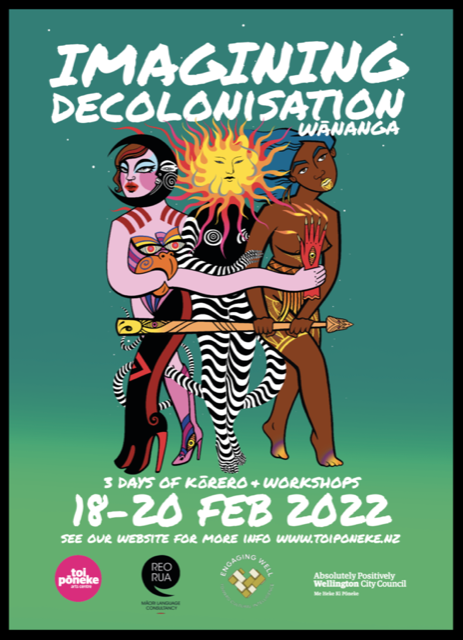
Some of New Zealand’s most divisive mischief-makers are
embedded in local government, where they appear free to pursue their ideological
agendas unencumbered by any checks or restraints, generously subsidised by
ratepayers who are given no chance to say whether or not they approve of their
money being spent on extremist causes.
A perfect example is a forthcoming 3-day wananga (forum)
organised by the Wellington City Council-funded Toi Poneke arts centre and
entitled “Imagining Decolonisation”, for which the capital’s long-suffering
ratepayers will pick up a big part – if not all – of the tab.
To convey the tone of this event, I can do no better than
quote from an official council press statement:
The event … will bring
together academics, students, artists, writers, treaty workers, activists,
politicians and change makers to discuss and create steps towards what an
equitable future in a decolonised Aotearoa could look like.
Wellington City
Council’s Tati Heke Karepa Wall [translation: head of Maori strategic relationships]
welcomes the event.
“Kua rewa anō te waka –
piki mai inā koia te koronga o te Ngākau kia kakea rā ngā tāpuhipuhitanga o te
whakaaro! So many in our community are now the new catalysts of decolonisation
simply because our community now better understands and appreciates the
complexities of Maori self-determination.
“We have been through
a process of unlearning some of our past – and now the time is to come together
and relearn in order for us to move forward together,” says Karepa.
The “Imagining
Decolonisation” wānanga provides a line-up of speakers and workshop leaders including
artists and musicians Ruby Solly and Ariana Tikao, Psychiatrist Dr Di Kopua,
academic Emalani Case (VUW), campaigner Kassie Hartendorp (Action Station),
environmentalist Catherine Delahunty (Kōtare), Councillor Tamatha Paul, Green
Party MP Dr Elizabeth Kerekere, dance artist Lusi Faiva, and youth activist
Safari Hynes. Experiential workshops across diverse mediums
will provide an opportunity for discussion and creative expression.
Councillor Tamatha
Paul is pleased to be a part of the event for a number of reasons.
“If Covid has shown us
anything, it is the illumination of deep-rooted inequality in New Zealand.
Amidst trying to keep our communities safe, trying to keep a roof over our
heads and stay afloat, there has been little time to dream of a decolonised
Aotearoa.
“I’m excited to be in
wānanga with rangatira and rangatahi to collectively imagine a better, fairer society
and to inspire action.”
(For a more detailed breakdown, if you have the fortitude, you can read the full programme here.)
It goes without saying that people are entitled
in a free society to indulge in undergraduate fantasies to their hearts’
content. Problem is, they always expect to do it using Someone Else’s Money,
and that Someone Else – in this case, the ratepayers of Wellington – usually gets
no say in the matter. That’s the real issue here.
The event has been planned and organised using
council staff, money and resources, so bears the council’s imprimatur despite
its flagrantly – indeed, provocatively – political nature. Whether attendees will
pay a fee to attend isn’t clear; but even if they do, we can be sure it won’t
go anywhere near covering the cost.
What, I wonder, does Mayor Andy Foster, who’s
nominally a conservative, think about the council’s backing for the wananga?
Does he approve, or did he look the other way because he’s intimidated by aggressive
activists on the council such as Tamatha Paul (whose fingerprints are all over
the event) and has no stomach for a fight?
Advocates of decolonisation want nothing less
than the total repudiation of Western civilisation, along with democratic government
and all the other benefits that flow from it. To be replaced by … what,
exactly? Participants in the wananga will have their own ideas about that, but their model for a decolonised New Zealand is unlikely to be one most New Zealanders would endorse.
On Waitangi Day, it’s possible to acknowledge
that some aspects of colonisation were catastrophic for Maori – most obviously
the loss of their land – while simultaneously regarding the neo-Marxist notion of
decolonisation as absurd and dangerous. Since when was it the cash-strapped Wellington
City Council’s function to sponsor a gab-fest for fringe extremists bent on
overturning the status quo?
One last thought. It’s probably too late to
suggest it now, but I’d be happy to speak to the wananga about my own imagining
of decolonisation. I would invite the participants to visualise a country where
there’s no rule of law, no democratic government or accountability on the part
of leaders, no wheel or internal combustion engine, no printed word, no science
or literature, no Western music, clothing, art or entertainment, no cities, no
schools or universities, no social welfare or government subsidies and no
economic development. I mean, if we’re serious about decolonisation, let’s go
the whole hog.