Showing posts with label Wellington City Council. Show all posts

Wednesday, April 16, 2025

Little stands to capture the 'Anyone but Whanau' vote

The least surprising news of the day is that Andrew Little has confirmed he will run for the Wellington mayoralty. I imagine the announcement will come as relief even to people not normally disposed to look favourably at a Labour Party stalwart. “Anyone but Whanau” is likely to be the catchcry, and I’m sure Nick Mills was right when he said on his NewstalkZB talkback show this morning that Little has to be the hot favourite – though there’s still a gap in the field for a late contender who combines political nous with the charisma that Little lacks.

The former Labour leader doesn’t strike me as a visionary, and nothing he said in an interview with Andrea Vance in The Post today has changed that view. No one should expect him to magically recapture the vibe that made Wellington New Zealand’s most exciting city in the 1990s and early 2000s.

Perhaps the best Wellington could hope for under a Little mayoralty is that he would be a far more competent and grounded manager than the incumbent. That wouldn’t be hard, I hear the cynics chorus; but it might be a modest first step on the city’s road to recovery.
 
Footnote: I haven't lived in Wellington for more than 20 years, so have no skin in this game. But I'm still a frequent visitor and grieve for the city that used to be.

Like
Comment
Copy
Share

Tuesday, March 18, 2025

Why shouldn't ACT have a go? The Left's been at it for decades

David Seymour’s announcement that ACT may stand candidates in council elections triggered a discussion on Nick Mills’ talkback show on Newstalk ZB this morning about whether political parties should get involved in local government. But that mischievous genie escaped from the bottle a very long time ago.

The Labour Party has long regarded local politics as fertile ground, both at district and regional levels, and always fields a slate of Wellington City Council candidates with the party’s formidable organisational resources behind them.

Frank Kitts, Wellington’s longest-serving mayor (1956-74), was elected on the Labour ticket; so were Jim Belich and Fran Wilde. Four of the current councillors owe their loyalty to Labour, though only one (Teri O’Neill) acknowledges her allegiance in her profile on the council’s website.

Wellington Regional Council chair Daran Ponter is a Labour man too, as is Lower Hutt mayor Campbell Barry. So Labour is a powerful force in local government, though it largely flies under the radar in terms of public visibility.

Then there are the Greens. Wellington got its first Green councillor, Stephen Rainbow, way back in 1989. Rainbow has moved a long way politically since then, shifting to the libertarian right to the extent that the current government felt comfortable appointing him as chief human rights commissioner, but there has been a more-or-less constant Green Party presence at the Wellington council table in the past few decades – to say nothing of two disastrous Green mayors, Celia Wade-Brown and Tory Whanau (who is Green in all but official designation).

So what about the other side? For decades Wellington had the conservative Citizens’ and Ratepayers’ Association, which was widely viewed as a National Party proxy. Its main purpose was to keep Labour out of power, in which role it was often successful. Sir Michael Fowler was a popular Citizens’ mayor (1974-83) and the Citizens’ Association often commanded a majority around the council table. But Ian Lawrence (1983-86) was the last Citizens’ mayor and the Citizens’ Association now seems defunct, not having stood a candidate since 1997. National itself has never stood candidates in council elections.

So now ACT is thinking about having a go – and why not? We should brace ourselves for howls of outrage, but ACT would only be doing what the Left has done (and very effectively) for decades.

Friday, March 18, 2022

Can Wellington rediscover its lost mojo?

I spent a couple of hours wandering the streets of downtown Wellington this week. What a dismal experience.

Actually, it was worse than dismal. It was profoundly depressing. The city where I spent most of my working life looks as if it has lost the will to live.

John Key got into a lot of trouble in 2013 for saying Wellington was a dying city. It seemed a preposterous statement then, but if Key said it today, I could only agree.

Absolutely Positively Wellington? That was the city’s confident – you might say brash – slogan in the 1990s. Now it sounds like a black joke. Ditto the phrase “Coolest little capital in the world”, which is how Lonely Planet (not an authoritative guide, even at the best of times) dubbed the city in 2014.

I’ve banged on about this before, here and here, so I won’t repeat myself. Suffice it to say that downtown Wellington resembles the urban wastelands of North American cities where you venture at your peril.

Lambton Quay on Tuesday was like a ghost town, Willis St only marginally better. Cuba Street, which once had an appealing raffishness, now looks just plain grotty. The CBD as a whole looks and feels tired and moribund.

Everywhere you look, businesses are closed or empty – a state of affairs documented in last Saturday’s Dominion Post. Beggars are ubiquitous, sometimes obtrusively so, and Cuba Mall is owned by derelicts.

Of course the city’s decline can partly be blamed on Covid-19, but the key word here is “partly”.

Many of the public servants and suits who normally patronise the city’s cafes and shops are working from home, and more worryingly may continue to do so even after the pandemic eases. The streets are also largely free of tourists – an absence for which Wellington should probably be grateful, since it would do the city’s image no good if word got out that downtown Wellington resembles the less salubrious parts of Flint, Michigan.

But Covid-19 has merely accelerated a decline that was already well advanced. For years the city has been in the grip of scaremongers and control freaks who used the hypothetical risk of earthquakes as an excuse to declare supposedly dangerous buildings off-limits. Risk-averse engineers, perhaps intoxicated by the power the Christchurch and Kaikoura earthquakes unexpectedly bestowed on them, keep raising the bar. Compliant bureaucrats fall into line.

The Reading cinema complex, which once generated a needed daytime buzz in Courtenay Place, remains closed. The public library and town hall, ditto. Oh, and the St James Theatre too. And now I see that the Michael Fowler Centre, which has already been strengthened once, is getting another earthquake-prone sticker “because more documentation is required to verify the building’s seismic status”. The wording says it all.

These are institutions that collectively help define the city’s identity. As long as they remain closed, Wellington will remain in a state of inertia, if not paralysis. By the time the buildings reopen, it may be too late.

Even the Asteron Centre, an architectural showpiece opened as recently as 2010 and presumably built to state-of-the-art standards, was hurriedly evacuated last year for fear of imminent collapse. Yet the Railway Station immediately opposite, built on reclaimed land in the 1930s, has remained opened for business throughout. Can anyone explain this apparent paradox?

What’s astonishing is that this wretched state of affairs seems to be stoically accepted as inevitable. Perhaps the fact that the city’s decline has been gradual over many years resulted in the people living in its midst not noticing. The frog-in-boiling-water analogy comes to mind. Alternatively, the citizens of Wellington may have been browbeaten into submission and become simply too demoralised to resist.

All of this brings us to the matter of the city’s leadership, or lack thereof. From 1992 till 2010, Wellington had a succession of mayors – Fran Wilde, Mark Blumsky and Kerry Prendergast – who were energetic, capable and ambitious for their city. That was the Absolutely Positively era.

The rot set in under Celia Wade-Brown and since then, things have gone from bad to worse. Wellington in 2022 is cursed with the worst possible combination: a weak, ineffectual mayor and a council of fractious activists, several of whom treat their office as a licence to pursue ideological agendas.

So while the city’s infrastructure crumbles and its social and commercial vitality inexorably wastes away, the council sprays money on pet causes such as  cycleways (cost: $334 million) and virtue-signalling gestures on climate change – to say nothing of the comically misnamed Let’s Get Wellington Moving, which has become a synonym for expensive and futile dithering.

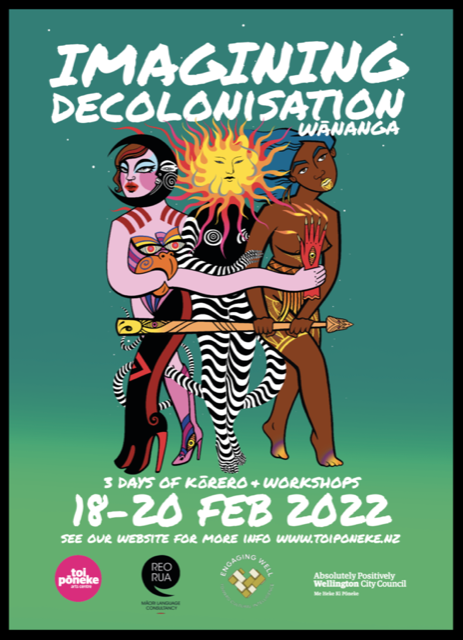
A striking example of the council’s resources being hijacked in pursuit of a radical political agenda – one not remotely connected with the concerns of ratepayers – is the proposed three-day wananga (forum) entitled Imagining Decolonisation, paid for by the council and promoted by councillor Tamatha Paul.

Official Information Act requests reveal that this “call to action” – the organisers’ own phrase – will cost Wellington ratepayers $35,000, including $6000 for something called cultural consultancy services. (That rumbling you just heard was the gravy train passing by.)

The quoted cost of the event should be treated as a starting figure because it doesn’t include time spent by council officials. But how the ratepayers will benefit from discussions about what “an equitable future in a decolonised Aotearoa could look like” isn’t clear.

Councillors who had the audacity to ask why the council was paying for an event that Cr Sean Rush described as radical and subversive were brushed off with bland assurances that different opinions could be voiced safely at the wananga and “held with care”, whatever that may mean. But it’s a fair bet that dissenting voices would have been firmly excluded had  councillors Rush and Nicola Young not started asking awkward questions. That was obvious from a council official’s acknowledgement that the postponement of the event due to Covid-19 would enable “wider participation”.

Whether the event will go ahead now that its true nature has been exposed (no thanks to the mainstream media, which have obligingly ignored the controversy) remains to be seen. In the meantime, there are important questions to be asked – such as, can Wellington rediscover and reclaim its mojo?

It will have an opportunity to at least make a start at the local government elections in October. What the people of Wellington must do is elect a mayor and council who reflect the priorities and aspirations of the city at large rather than those of a vociferous minority.

That won’t be easy, because Wellington is home to New Zealand’s greatest concentration of woke zealots. They are well organised, ferociously committed and have the support of a broadly sympathetic media, many of whose journalists are of a similar ideological persuasion.

The Left has made an early start. Tory Whanau declared herself a candidate for the mayoralty in November and has been energetically promoting herself at every opportunity. Whanau has no local government experience, but the fact that she’s a former chief of staff for the Green Party provides a clear pointer to the type of mayor she would be. It will also ensure the support of the impressionable young and the idealistic New Left from the inner suburbs.

She certainly doesn’t lack self-assurance, judging by a lavish photo spread in Capital magazine (what was that I said about sympathetic media?). But Whanau as mayor would be a disaster – a guarantee that the city would continue on its present wayward course, albeit even faster.

The question is, who will stand against her? Speculation centres on former deputy mayor Paul Eagle, now the Labour MP for Rongotai.  Eagle was generally well-regarded on the council and would have almost certainly been mayor by now had he not been seduced by the lure of Parliament in 2017. But he hasn’t enjoyed a high profile as an MP and might well be tempted to return to local government.

If he does, and stands as an official Labour candidate, he would presumably have the backing of the Labour Party machine, which would help counter the inevitable social media blitz promoting Whanau. And while party involvement in local government is not something to be encouraged, Eagle as mayor could at least be expected to counter the malignant elements who now hold sway around the council table.  

Whoever wins the mayoralty will need to be bold, decisive and visionary, because Wellington is a city that has tragically lost its way. Whether it can get its bearings again is in the hands of the voters.


Wednesday, February 16, 2022

Oh dear, how sad, never mind

Word reaches me that the mischievous, publicly funded three-day wananga (forum) entitled Imagining Decolonisation, which was to have started in Wellington this Friday, has been put on hold. Oh dear, how sad, never mind, as the Sergeant-Major in It Ain't Half Hot Mum might have said.

The reason given is that the Covid-19 red traffic light setting made it too risky to proceed, but another likely factor not mentioned by the organisers is that hard questions were being asked behind the scenes at Wellington City Council about who authorised this flagrantly ideological event and how much it was likely to end up costing long-suffering Wellington ratepayers.

Either way, the postponement should be regarded as a win and may yet become a cancellation. The organisers say they are still committed to holding the event, but councillors and citizens outraged by this misuse of public money now have more time to mobilise in opposition.  Council staff are not employed – and more to the point, councillors like Tamatha Paul are not elected – to pursue divisive radical agendas at the public’s expense and with no mandate.

Saturday, February 5, 2022

If we're going to talk about decolonisation, let's go the whole hog


Some of New Zealand’s most divisive mischief-makers are embedded in local government, where they appear free to pursue their ideological agendas unencumbered by any checks or restraints, generously subsidised by ratepayers who are given no chance to say whether or not they approve of their money being spent on extremist causes.

A perfect example is a forthcoming 3-day wananga (forum) organised by the Wellington City Council-funded Toi Poneke arts centre and entitled “Imagining Decolonisation”, for which the capital’s long-suffering ratepayers will pick up a big part – if not all – of the tab.

To convey the tone of this event, I can do no better than quote from an official council press statement:

The event … will bring together academics, students, artists, writers, treaty workers, activists, politicians and change makers to discuss and create steps towards what an equitable future in a decolonised Aotearoa could look like.

Wellington City Council’s Tati Heke Karepa Wall [translation: head of Maori strategic relationships] welcomes the event.

“Kua rewa anō te waka – piki mai inā koia te koronga o te Ngākau kia kakea rā ngā tāpuhipuhitanga o te whakaaro! So many in our community are now the new catalysts of decolonisation simply because our community now better understands and appreciates the complexities of Maori self-determination.

“We have been through a process of unlearning some of our past – and now the time is to come together and relearn in order for us to move forward together,” says Karepa.

The “Imagining Decolonisation” wānanga provides a line-up of speakers and workshop leaders including artists and musicians Ruby Solly and Ariana Tikao, Psychiatrist Dr Di Kopua, academic Emalani Case (VUW), campaigner Kassie Hartendorp (Action Station), environmentalist Catherine Delahunty (Kōtare), Councillor Tamatha Paul, Green Party MP Dr Elizabeth Kerekere, dance artist Lusi Faiva, and youth activist Safari Hynes. Experiential workshops across diverse mediums will provide an opportunity for discussion and creative expression.

Councillor Tamatha Paul is pleased to be a part of the event for a number of reasons.

“If Covid has shown us anything, it is the illumination of deep-rooted inequality in New Zealand. Amidst trying to keep our communities safe, trying to keep a roof over our heads and stay afloat, there has been little time to dream of a decolonised Aotearoa.

“I’m excited to be in wānanga with rangatira and rangatahi to collectively imagine a better, fairer society and to inspire action.”

(For a more detailed breakdown, if you have the fortitude, you can read the full programme here.)

It goes without saying that people are entitled in a free society to indulge in undergraduate fantasies to their hearts’ content. Problem is, they always expect to do it using Someone Else’s Money, and that Someone Else – in this case, the ratepayers of Wellington – usually gets no say in the matter. That’s the real issue here.

The event has been planned and organised using council staff, money and resources, so bears the council’s imprimatur despite its flagrantly – indeed, provocatively – political nature. Whether attendees will pay a fee to attend isn’t clear; but even if they do, we can be sure it won’t go anywhere near covering the cost.

What, I wonder, does Mayor Andy Foster, who’s nominally a conservative, think about the council’s backing for the wananga? Does he approve, or did he look the other way because he’s intimidated by aggressive activists on the council such as Tamatha Paul (whose fingerprints are all over the event) and has no stomach for a fight?

Advocates of decolonisation want nothing less than the total repudiation of Western civilisation, along with democratic government and all the other benefits that flow from it. To be replaced by … what, exactly? Participants in the wananga will have their own ideas about that, but their model for a decolonised New Zealand is unlikely to be one most New Zealanders would endorse. 

On Waitangi Day, it’s possible to acknowledge that some aspects of colonisation were catastrophic for Maori – most obviously the loss of their land – while simultaneously regarding the neo-Marxist notion of decolonisation as absurd and dangerous. Since when was it the cash-strapped Wellington City Council’s function to sponsor a gab-fest for fringe extremists bent on overturning the status quo?

One last thought. It’s probably too late to suggest it now, but I’d be happy to speak to the wananga about my own imagining of decolonisation. I would invite the participants to visualise a country where there’s no rule of law, no democratic government or accountability on the part of leaders, no wheel or internal combustion engine, no printed word, no science or literature, no Western music, clothing, art or entertainment, no cities, no schools or universities, no social welfare or government subsidies and no economic development. I mean, if we’re serious about decolonisation, let’s go the whole hog.


Saturday, May 1, 2021

Joyous hugs and kisses as democracy takes another hit

Democracy took centuries to build, but it’s being dismantled with frightening speed.

The latest step in the demolition job was Wellington City Council’s decision this week to give full voting rights on council committees to two unelected iwi representatives. They will each be paid a yearly fee of $111,225, the same amount as elected councillors, despite having undefined responsibilities and lines of accountability that could only be described as highly opaque. 

A triumphant council statement said the 11-3 vote was greeted with waiata, hongi, hugs and kisses. Cr Jill Day, one of two legitimately elected part-Maori councillors, said: “This is just a small step, but we need to make a start.”

Just a start – really? It’s anyone’s guess where Day envisages it leading to, but anything’s possible once you sever the vital, direct connection between voters and those purporting to represent them.

The council’s decision alters the basis of local government so profoundly that the word democracy, which hinges on people electing their representatives, will no longer apply. Once you start dismantling the checks and balances that ensure councillors are elected by popular vote under a transparent process, and can be tossed out if they don’t measure up to the people’s expectations, the line has been crossed between democracy and some other form of government for which we haven’t got a name.

How will the iwi representatives be chosen, and by whom? We don’t know.

Who will they be accountable to? That, too, is unclear. But we can make a safe guess that it won’t be to the wider public or the ratepayers who will fund their salaries, and who pay to keep the city functioning (after a fashion). The iwi representatives will owe their loyalty to the runanga, tribal leaders or hui that choose them. Whatever this is, it’s not democracy.

Naturally, the council’s vote was greeted effusively by iwi representatives, whose comments neatly avoided inconvenient issues of democratic principle.  John Coffey, chairman of the embattled and strife-torn Port Nicholson Block Settlement Trust, gushed that iwi and the council shared similar goals. “What you want as a council for the people of Wellington is what we want too,” he told councillors. “You will not succeed without us, and we will not succeed with you. It’s as simple as that.” Er, meaning what, exactly?

Better still was the stirring oration from the chief executive of Ngati Toa Rangatira, a man with the proud Maori name of Helmut Modlik: “I’m feeling very grateful that I’m living now, and that we’re at a point in history where there is a degree of honesty about the past ... it is a tragic story for my people in a lot of respects,” said Modlik. “But that’s the past, and a line’s been drawn. And I’m grateful to live today and to be a witness to what I expect to be an increasingly emergent determination by New Zealanders to do better for our children and our mokopuna than was done in the past.”

So … bad things have happened to Maori, which is unquestionably true, and the only way to remedy these grievances is by subverting and even destroying the fair and equitable form of government we know as democracy? I think that’s what he was saying, but who can tell?

Still to come, of course, is the introduction of Maori wards – a change facilitated under urgency with virtually no warning by a dishonest government, and one premised on the palpable falsehood that the only way Maori can get elected to councils is through the creation of a voting system that treats them as different, with special needs.

This ignores the fact that city and district councils throughout New Zealand, including Wellington, have had many Maori councillors – and mayors too (Ron Mark and Georgina Beyer in Carterton, Mike Tana in Porirua and Derek Fox in Wairoa are four who come to mind from relatively recent history) – who were elected by popular vote. So much for the lie that a racist system is loaded against Maori candidates, and that they can succeed only through preferential treatment. So much, too, for the condescending view – a view apparently held, remarkably, by most Maori leaders – that Maori candidates aren’t capable of being elected on their own merits

Wellington City Council, like many others, took advantage of the sneaky law change by voting in favour of the creation of Maori wards, knowing the decision could no longer be thwarted by a referendum, as it has been elsewhere. But Jill Day and her youthful, activist fellow councillor Tamatha Paul are living, breathing proof that Maori candidates don’t need Maori wards to get elected. 

Of course, whether Wellington voters will want Day and Paul back next year, after the current council’s embarrassingly shambolic performance, is another matter. Speaking of which, I wouldn’t give Mayor Andy Foster much for his chances in the 2022 local government elections.  Foster long ago proved himself ineffectual and now he’s been exposed as spineless too. He was one of six councillors who voted only a few weeks ago against the appointment of iwi representatives, saying then that he wanted to ask for public feedback. But at Wednesday’s meeting he performed an about-face of breathtaking brazenness, saying councillors needed to have faith that the community would support their decision. “While this is not something that has been consulted on, I think we should give this a go.”

That sounds to me like a man who no longer bothers to maintain even a pretence of being in control. Foster seems to have given up, and the only question is whether he'll cling to office till the voters toss him out next year, as they surely will, or cut short the pain and humiliation by walking now.


Friday, March 12, 2021

In New Zealand today

■ It was drearily predictable that young, female commentators online and in print would unquestioningly accept Meghan Markle’s account of the affronts and injustices supposedly heaped upon her. So it was refreshing to see the New Zealand actress Teuila Blakely suggest that perhaps the “racist” comment about the colour of young Archie’s skin – supposedly made by a member of the royal family who remains unidentified (if indeed it was made at all) – might not have been so racist after all.

In these situations, as Blakely (who is of mixed race) points out, context can be everything. “At a time where [sic] racism is at the forefront of our world in terms of creating awareness around it, I think [those comments] can be damning,” the New Zealand Herald reported her as saying. “[But] I think what’s really important to remember [is] we didn’t understand the context of that conversation or how those those concerns were presented.

“For the royal family, who have never had a person of colour come into their ranks before, the possibility that their first great-grandchild could be coloured would be a conversation you would have.” She said similar conversations had happened in her own extended family when her Samoan mother entered the picture.

The Herald reported the former Shortland Street star as saying the context of the situation dictated whether the comment was the product of racism or something more innocent.

Precisely. Until we know in what context the supposedly racist comment was made – and specifically what was said, by whom and in what tone – we can’t judge whether it was malignant or harmless. But that hasn’t stopped Markle’s enraged supporters automatically concluding that she has been grievously wronged and that the Windsors are a family of contemptible white supremacists.

And here’s another thing. It’s Markle who insists on making an issue of her race and therefore presenting herself as a victim. Is it possible that the fact she and Archie have African-American blood actually doesn’t matter to most people, including the royal family?

■ So Wellington City Council has voted 12-3 to establish a Maori ward. “Maori voices must be at the table; it can’t be left to chance,” said Cr Jill Day, who is of Ngati Tuwharetoa lineage.

Spot something odd in that statement? That’s right – Maori voices are already at the table. Day is one of two councillors who identify as Maori, the other being Tamatha Paul.

They were elected without the benefit of a Maori ward and there’s nothing to stop other Maori candidates from being similarly elected, provided they put themselves forward for office and persuade voters to support them, just as Day and Paul did. I could also mention Paul Eagle, who was seven years a councillor and would almost certainly now be mayor of Wellington if he hadn’t been elected MP for Rongotai (a general electorate where in the last election he won 57 percent of the votes competing on equal terms with every other candidate).

Oh, and we shouldn’t forget Ray Ahipene-Mercer, who served on the council for 16 years and is quoted in the Dominion Post today as questioning whether a Maori ward is necessary. “I would only ever stand on the same basis as any other person, irrespective of ethnicity,” Ahipene-Mercer said. Good on him.

“It can’t be left to chance” is an absurd statement. The only element of chance in winning election to the council is the one faced by all candidates. They have to convince voters to support them. That’s how democracy works.

Or at least it did, until now. But the legislation that was shamefully rushed through Parliament last month under urgency – the legislation Labour was careful to keep quiet about during last year’s election campaign – fundamentally changes the dynamics of local democracy by introducing race-based wards, thereby bestowing on Maori a privilege not enjoyed by other sectors of the community (and one they clearly don’t need, as the election of Eagle, Ahipene-Mercer, Day and Paul, not to mention  the many Maori councillors in other districts, shows).

Already there are signs that this may turn pear-shaped. Liz Mellish, speaking for an iwi grouping that regards Wellington as its rohe, or territory, is quoted today as saying she wants to know who would be eligible to vote in the Maori ward and how the new arrangement would affect her organisation's relationship with the council. “In a city like Wellington, we as mana whenua are outnumbered by other Maori. We need to ensure that mana whenua relationship continues.”

This sounds like an assumption of prior rights based on iwi affiliation, regardless of numbers or voter support, and seems to bear out warnings that tribalism and democracy are fundamentally incompatible.

The last thing Wellington needs now, on top of all its existing torments, is the prospect of an iwi power struggle over who has the right to represent the new Maori ward. But perhaps the city should start bracing itself for more convulsions.

■ A New Zealand Herald story today – I won’t embarrass the reporter by naming him – quotes Chris Hipkins as saying, in relation to criminal deportees from Australia: “To all intensive purposes many have lived the vast bulk of their lives in Australia.”

Good grief. I imagine that Hipkins actually said "to all intents and purposes" - a phrase perhaps unfamiliar to the reporter. The current generation of journalists, at least on paper, is probably the most educated in history. So why do so many write as if English is their second language?

Friday, January 29, 2021

In New Zealand today

■ Susie Ferguson is a disgrace. Interviewing Hone Harawira on Morning Report this morning about the police decision to shut down iwi checkpoints on highways in the Far North, she seemed at pains to avoid even the remotest hint that the checkpoints weren’t legitimate in the first place.

I would have been content if she had asked Harawira just one crucial question – namely, by what authority did he and his fellow activists set up the checkpoints? Harawira holds no public office and is accountable to no one. He has no public mandate. On the contrary, Maori voters in Te Tai Tokerau rejected him in the 2014 and 2017 general elections. He leads a far-left political splinter group called the Mana Movement, which won a resounding 0.1 per cent of the party vote in the last election it contested. So who or what gives Harawira the right to stop traffic on public roads?

My beef, however, isn’t with Harawira. He’s a seasoned political opportunist who will seize every chance to assert Maori autonomy, which is what the checkpoints are about. He owes the public nothing.

Ferguson, on the other hand, occupies a position of public influence and authority which she regularly abuses. This morning she ingratiated herself with Harawira by asking soft, leading questions (for example, “Are you concerned that the government is making decisions that are not in the best interests of Maori as regards this current outbreak?”, to which there was only going to be one answer) and murmuring assent to his replies.

The crucial question raised by unauthorised iwi checkpoints is this: either New Zealand is a society based on the rule of law, in which authority is exercised by people who are publicly accountable, or it’s a free-for-all where anyone with sufficient audacity (which Harawira has by the bucketload) can claim rights not available to others, such as pulling motorists over and disrupting traffic on the pretext that they want to give people information that’s freely available elsewhere. But Morning Report and Susie Ferguson delicately tiptoe around such inconvenient issues.

■ Duncan Greive, founder and managing editor of the left-wing news and commentary site The Spinoff, has unblushingly outed himself as an enemy of free speech.

In a commentary on John Banks’ sacking by Magic Talk, Greive suggests the station’s boss, former Air New Zealand executive Cam Wallace, should either restrain Magic Talk’s other conservative talkback hosts – he names Peter Williams and Sean Plunket – or “ease them out”. The problem, evidently, is that they express and invite right-wing opinions, which makes Magic Talk something of an outlier in an otherwise overwhelmingly woke media environment.

Greive then goes on to say: “… This is not just a question for Wallace and his board. It’s a question for us, for New Zealand. Because the views espoused by Banks and his caller, dismal as they are, remain out there and available on any number of platforms. His axing doesn’t change that.”

Translation: New Zealand will never achieve ideological purity until it’s purged of dissenting conservative opinions. Greive laments that such opinions persist, but there’s a remedy: the spittle-flecked, drooling knuckle-draggers who hold them should be denied a public platform. How very open and inclusive.

He goes on to sneer not only at talkback audiences but writers of letters to the editor as well, observing that such people are “older and further from the centre of society’s gravity than they once were”. Translation: old people should shut up and stand aside in favour of younger, wiser heads.

Well, at least we now know exactly where we stand with Greive and The Spinoff. He wishes to assert the right of free speech for himself but deny it to others.

■ Wellington’s abject humiliation continues. Earlier this week, sewage flowed in the central city after an ancient pipe burst. Yesterday a geyser erupted in the Aro Valley; same cause.

Interviewed by Corin Dann on Morning Report this morning, mayor Andy Foster made a valiant effort to sound confident and in command, but he’s not fooling anyone. He talks as if the city’s epidemic of failing pipes took everyone by surprise, but hang on; Foster has been on the council since 1992, so can hardly plead ignorance of the city’s decay. What was he doing all that time?

Ageing infrastructure isn’t Wellington’s only problem. The city is burdened with an ineffectual mayor struggling to assert control over a fractious council dominated by shrill, woke harpies. Its finest public buildings lie empty and its most ambitious projects (the Shelly Bay development and the laughingly named Let’s Get Wellington Moving initiative) are bogged down by indecision, sclerosis and litigation.

How long will it be, I wonder, before the city’s long-suffering citizens – especially those old enough to remember prouder times – stage an insurrection?

Saturday, December 2, 2017

A rampant culture of entitlement

(A slightly shorter version of this column was first published in The Dominion Post, December 1.)

A pervasive culture of entitlement and self-indulgence seems to have taken root in some of our public institutions.

At its most egregious, it can be seen in the case of Nigel Murray, the disgraced former Waikato District Health Board CEO who treated himself to $218,000 worth of unauthorised spending on personal travel and expenses.

By comparison, the extravagant restaurant bills totted up by Peter Biggs and Chris Whelan, respectively the chairman and former CEO of the Wellington Regional Economic Development Agency (Wreda), are a mere bagatelle. But it’s only a matter of scale.

Inquiries by this paper under the Official Information Act flushed out the information that Biggs and Whelan had given their Wreda credit cards a thrashing at some of Wellington’s classiest restaurants.

Is this anyone else’s business? Too right it is, because Wreda is largely funded by Wellington ratepayers.

Biggs has since paid back $4673 – this, after Wellington mayor Justin Lester blew the whistle. Biggs’ restaurant bills included $875 for dinner with New Zealand’s London Trade Commissioner and his wife, a $585 dinner with Wellington City Council chief executive Kevin Lavery and a $318 dinner with Derek Fry, also from the city council.

No restaurants were named in the Dominion Post report, but I think we can safely assume we’re not talking about Burger King.

The fact that Biggs voluntarily repaid the money suggests that after talking to Lester, he had second thoughts about whether his spending was justified. But before his own taste for fine dining became public, he was unapologetic about Whelan’s expenses (which he had approved), and defended his former CEO’s right to bury his snout in the city’s poshest troughs.

According to Biggs, Whelan’s selfless hard yakka over the fine white linen table cloths at Logan Brown, Zibibbo and Shed 5 produced measurable results. It had helped attract a call centre and Singapore Airlines to Wellington and generated business for Westpac Stadium.

When asked whether Whelan really needed to put 36 Bluff oysters on his credit card at Shed 5 (cost: $216) in order to secure that new business, Biggs rather testily rebuked the reporter for taking a “cynical” view.

The spending could be looked at as a way of showcasing Wellington’s “vibrancy and sophistication, and also building collegiality”, he said. “It depends on whether you know how the real world works.” Hmmm.

Here we get to the heart of the issue. In the “real world” that Biggs inhabits (his background is in advertising), it has become accepted wisdom that lavish lunches and dinners are an indispensable part of doing business.

This suits the participants splendidly. They all fete each other and then justify it by insisting it’s generating business or “building collegiality”.

And because everyone does it and expects it, it becomes self-reinforcing and self-perpetuating. No one ever questions whether it’s necessary. Why spoil things?

Biggs gave the additional justification that Whelan’s job involved showcasing the Wellington region’s cuisine and wine. Well, of course. That’s all the excuse anyone needs to slurp some of New Zealand’s most expensive wine. “We’ll try the Martinborough Vineyard pinot noir next, waiter.” There’s $155 gone, right there.

But hang on a minute. Biggs’ explanation that it’s all about promoting Wellington unravels when you consider that an $1100 dinner for 10 at Zibibbo was for the boards of Wreda and its subsidiary agency, Creative HQ. After all, you hardly need to promote Wellington to people whose job is to, er, promote Wellington.

Presumably the dinner in this instance qualified as “building collegiality”. But to most people it just looks like an excuse to have a grand time at someone else’s expense.

In the light of Biggs’ previous comments, you also have to wonder what business he generated for Wellington by dining with Lavery and Fry. I mean, he surely didn’t need to convince them – council executives both – of Wellington’s “vibrancy and sophistication”.

Fry, incidentally, is now the interim chief executive of Wreda after Whelan stepped down earlier this year. In this role, Fry will be expected to curb the excesses of which he has previously himself been a beneficiary. It all looks decidedly clubby.

As for Lavery … well, some of us remember an era when town clerks cycled to work carrying a paper bag containing luncheon-sausage sandwiches and a granny smith apple. Now they’re called chief executives and, in Lavery’s case, pocket more than $400,000 a year. Can’t he afford to buy his own lunch?

Part of the problem is that Wreda is one of those agencies that inhabit the nebulous territory between the public and private sectors. And while Wreda has “rules” on how entertainment money is to be spent, they are loose enough to allow very liberal interpretation – which is exactly what seems to have happened on Biggs’ watch. We’re left with a clear impression of a culture where a sense of entitlement was rampant.  

The traditionally frugal public-sector ethos doesn’t stand a chance when it has to compete with the temptations presented by a corporate credit card. To put it another way, what CEO with pretensions of grandeur is going to choose a sandwich in the office over lunch at Logan Brown? After all, this is the real world we’re talking about.

Saturday, April 20, 2013

A roomful of teddy bears could hardly do worse


(First published in The Dominion Post, April 19.)

WELLINGTON could save itself a truckload of money by getting rid of its mayor and 14 councillors and replacing them with teddy bears.
Would the quality of governance be affected? Not a jot. The council bureaucrats would continue to run things just as they do now.

The people’s elected representatives are obviously not in control at the Town Hall and it’s an elaborate charade to pretend that they are. That’s clear from the fact that councillors had no idea 150 infrastructure jobs were being outsourced.
Even more comically, council functionaries didn’t bother to inform the mayor that they were proposing to spend $350,000 tarting up a temporary office for her. That shows how much regard the bureaucrats have for their elected overseers.

It’s all eerily reminiscent of an article published in The Dominion more than 20 years ago, in which an investigative reporter named Al Morrison – now better known as the director-general of the Department of Conservation – exposed the existence of a brotherhood of senior council officials known as the Order of the Rabbit.
Their purpose was to keep councillors in their proper place – in other words, in the dark. Those aspiring to join the said order had to swear they would maintain a tradition of regarding all councillors as “a pack of bastards”.

In this respect, Wellington is hardly unique. In local government, real power often resides with the managers. But in Wellington’s case, it’s a lot more obvious than usual.
Hence my suggestion that the council abandon the façade of participatory democracy and replace the councillors with stuffed toys. Meetings would be over faster, the bickering and point-scoring would cease, ratepayers would be saved more than $1.3 million a year – which is what they pay the mayor and councillors – and council officials would be free to get on unhindered with what they do anyway, which is running the show.

It would have the added benefit that most of those around the council table would be better looking.
* * *

ON A LESS flippant note, perhaps local government could learn something from the United States Constitution.

No one can serve more than two terms as US president. A similar rule in local government would clear out a lot of dead wood.
Under the present system, people can keep winning re-election ad infinitum. Councils become self-perpetuating, if often highly fractious, oligarchies.

The more often a councillor is elected, the more likely he or she will be elected again next time – not necessarily because they have done their job well, but because voters recognise their names on the ballot paper. 
The cunning ones soon learn the tricks of political longevity: they turn up at the right functions, make sure they’re prominent in the media and take a populist position on controversial issues. This can be more rewarding than hard graft behind the scenes.

In Wellington’s case, Helene Ritchie is the standout survivor, having first been elected in 1977. Other long-serving councillors are Andy Foster (1992), the mayor, Celia Wade-Brown (1994), Stephanie Cook (1995), Bryan Pepperell (1996), John Morrison and Leonie Gill (both 1998), and Ray Ahipene-Mercer (2000).
Admittedly, it can be useful to have councillors who have been around a while and know the ropes. Besides, some long-serving councillors are conscientious and hard-working. But there are others you couldn’t trust to feed your cat.

The trouble is, voters often can’t tell which is which.
Wellington is a dynamic, creative city that deserves a council to match. Unfortunately many of the incumbents give the impression of having run out of ideas and energy years ago and now merely keep their seats warm.

* * *

WHO WOULD have thought that animism, the belief that inanimate objects possess a living soul, could be taken seriously in a 21st century court of law in secular New Zealand? 
Such beliefs are generally associated with primitive tribes untouched by civilisation. Yet when a helicopter pilot appeared in the Timaru District Court charged with unlawfully hovering on the summit of Aoraki/Mt Cook, the Department of Conservation told the court – in what was laughably called a “summary of facts” – that the mountain represented, to Ngai Tahu, “the most sacred of ancestors, from whom Ngai Tahu descend and who provide the iwi with its sense of communal identity, solidarity and purpose”.

Ngai Tahu are of course entitled to believe they are descended from a mountain, just as they are welcome to believe in Papatuanuku, the earth mother, and others in the pantheon of Maori mythology. And if the chopper pilot knowingly broke the law, he deserved to be pinged.
But isn’t it taking cultural sensitivity to the point of absurdity when a government department advances superstition as “fact” in a court of law? It invites ridicule.

Oddly enough, the people most likely to nod approvingly at such mumbo-jumbo are those who are most contemptuous of religion in any other form.


Saturday, December 29, 2012

Are Brits the people to run our public sector?


(First published in The Dominion Post, December 28.)
TWO RECENT events – education secretary Lesley Longstone’s abrupt departure and the appointment of Kevin Lavery as chief executive of Wellington City Council – have touched off an overdue debate about the wisdom of appointing Brits to top public sector jobs.

Ms Longstone, who was recruited from England, joined a New Zealand public service already top-heavy with appointees from the UK.
Other British department heads include Gabriel Makhlouf at the Treasury and David Smol at the new super-ministry, the Ministry of Business, Innovation and Employment (although to be fair, Mr Smol has been here for some time).

Both men seem well regarded. Yet when Brits are appointed to lead three of our most crucial departments of state, not to mention several lesser government agencies – including, ironically, Te Papa, which supposedly embodies what it means to be a New Zealander – it’s time to start asking why there were apparently no suitable local candidates.
Did they not come forward, or were they judged to be inferior to those from the British Isles? If it’s the latter, perhaps we have yet to overcome the cultural cringe which holds that overseas people must be more capable than we are.

In Ms Longstone’s case, things didn’t work out. Perhaps British appointees are better suited to advising on esoteric policy matters than trying to run  departments such as education, which are close to the ground and have a profound impact on ordinary New Zealanders in their everyday lives.
Now Mr Lavery, from Cornwall, has been appointed Wellington’s top bureaucrat. He can expect his performance to be scrutinised very closely, especially as he was chosen at the expense of a New Zealand incumbent whom most agree has done a good job.

The issue is not whether the British appointees have the right credentials on paper. Even her critics conceded that Ms Longstone came with an impressive CV. But our culture, attitudes and ethos are different. Decades have passed since we took our cue from what we then respectfully called the Mother Country.
British recruits inevitably bring with them their own cultural baggage, which may not be compatible with our way of doing things. As a Massey University academic (another Pom, as it happens) remarked of Ms Longstone, she was possibly not well-equipped to read the New Zealand mood.

She is hardly the first such appointee to come unstuck here. If the State Services Commission goes back through its files, it will find no shortage of high-level overseas appointees who terminated their contracts prematurely, apparently after finding things weren’t quite as they expected.
Invariably the hapless taxpayer ends up picking up the tab. Perhaps it’s time to consider a different approach.

* * *
STILL, you can’t entirely blame the British for wanting to escape. They must sometimes feel like strangers in their own country.

The latest census showed that white Britons are now a minority in London. More than 7 million, or one in eight, of the people in England and Wales were born abroad – one in eight.
There’s a lot to be said for cultural diversity, but it’s surely impossible to sustain immigration on such a scale without fundamentally altering a society. Were the British given any say in this? Most would probably say they were not.

This is not a racist argument. The same would apply if Tonga was suddenly swamped with immigrants from China.  It’s not a matter of race, but the right of people to preserve their society as they know it.
Perhaps the cruellest irony is that some immigrant groups in Britain are so hostile to their host country that they commit acts of terrorism against it. France, the Netherlands and other European countries have experienced similar smouldering resentment from migrant communities.

There are lessons here for New Zealand, which is undergoing profound demographic change of its own. Most of us welcome the more vibrant and colourful society that a liberalised immigration policy has created – but it has to be carefully monitored and managed.
* * *

THREE expressions I hope not to see or hear in 2013:
“Added bonus”. By definition, a bonus is something additional. That means an added bonus must be a bonus on top of a bonus. It’s a nonsense.

“Signed off on”. Some of us recall a distant time when things were approved. Now they are “signed off”, a term that makes no sense whatsoever, or even more bizarrely, “signed off on” (as in, “the cabinet has signed off on more Treaty settlements”).  Hanging is too good for perpetrators of this atrocity.
“Fur children”. I heard a marketing executive from a chain of pet stores say on the radio that this is now the preferred term for your cat or dog. The radio interviewer was too polite to say it, so I’ll do it for him: anyone neurotic enough to call their pets fur children should be barred by law from owning any.